Introduction
Founded in 1911 in the twilight of the Qing Dynasty, Tsinghua’s origins are deeply intertwined with complex international diplomacy and the urgent national desire for modernization. Over the past century, it has evolved from a preparatory school for students heading to the United States into a comprehensive, world-leading research university. Its motto, *Ziqiang Buxi, Houde Zaiwu* (Self-discipline and Social Commitment), permeates every aspect of campus life, forging an environment where microscopic academic rigor meets an unwavering sense of duty to the nation and the global community.
Today, Tsinghua University is not merely a place of learning; it is an elite crucible. The students who walk its sprawling, picturesque campus—built atop the former royal gardens of the Qing Dynasty—represent the absolute apex of academic achievement, having survived the most grueling standardized testing system on the planet. This comprehensive profile delves deep into the fabric of Tsinghua University. It traces its dramatic historical evolution, dissects its expansive academic structure, explores the nuances of its brutal selectivity, and paints a vivid picture of the relentless, highly spirited student life that beats within the heart of China’s most prestigious academic institution.
The Comprehensive History of Tsinghua
Origins: The Boxer Indemnity and Founding (1911)
The genesis of Tsinghua University is uniquely rooted in international conflict and diplomatic restitution. Following the Boxer Rebellion at the turn of the 20th century, the Qing government was forced to pay massive reparations, known as the Boxer Indemnities, to an alliance of foreign nations. However, recognizing that the indemnity exacted by the United States was excessive, U.S. President Theodore Roosevelt and Secretary of State John Hay, persuaded by the lobbying of Chinese ambassador Liang Cheng, agreed to remit a portion of the funds back to China. The specific condition for this remittance was that the funds be used to establish an educational institution in Beijing and to fund scholarships for Chinese students to study in America.
Consequently, in 1911, “Tsinghua Imperial College” (Qinghua Xuetang) was founded. It was established on the grounds of the Tsinghua Garden, a former royal estate belonging to a Qing Dynasty prince. Initially, the institution served exclusively as a preparatory school for young Chinese men selected to pursue higher education in the United States. The curriculum heavily emphasized English, Western sciences, and American cultural norms, designed to bridge the vast intellectual gap between a declining empire and the rapid industrialization of the West.
Transformation into a National University (1928)
Following the Xinhai Revolution that overthrew the Qing Dynasty, the school was renamed Tsinghua College in 1912. The institution rapidly outgrew its preparatory mandate, expanding its academic scope to offer full undergraduate degrees. By 1928, it was officially re-chartered as National Tsinghua University (NTHU). During this golden era in the 1920s and 1930s, Tsinghua became a vibrant hub of free thought, academic excellence, and intense political debate. It attracted China’s greatest intellectual luminaries, including scholars like Liang Qichao and Wang Guowei, who blended traditional Chinese philosophical rigor with Western scientific methodologies.
The Sino-Japanese War and the Lianda Era (1937–1946)
The outbreak of the Second Sino-Japanese War in 1937 forced a dramatic and perilous chapter in Tsinghua’s history. As Japanese forces advanced on Beijing, the university, along with Peking University and Nankai University, was forced to evacuate southward to escape occupation. The three universities ultimately relocated to Kunming, in the southwestern province of Yunnan, where they merged to form the National Southwestern Associated University, commonly known as “Lianda.”
Operating under conditions of extreme poverty, constant threat of aerial bombardment, and severe lack of resources, the Lianda era is romanticized as one of the most heroic periods in Chinese academic history. Professors and students lived in mud-brick huts and conducted experiments with improvised equipment. Despite the immense hardship, Lianda produced an astonishing array of world-class scholars, including two future Nobel Laureates in Physics (Chen-Ning Yang and Tsung-Dao Lee), proving that the spirit of Tsinghua was not tied to its Beijing buildings, but to the resilience of its people.
The 1952 Restructuring and The Soviet Model
Following the conclusion of the Chinese Civil War and the establishment of the People’s Republic of China in 1949, higher education underwent a massive, systemic overhaul. In 1952, the Chinese government restructured all national universities to adopt the Soviet educational model, which favored highly specialized, utilitarian institutions over broad, comprehensive liberal arts universities.
As a result, Tsinghua University was stripped of its colleges of law, arts, humanities, and agriculture, which were transferred to Peking University and other institutions. Tsinghua was deliberately transformed into a multidisciplinary polytechnic institute entirely focused on engineering and applied sciences. For the next three decades, Tsinghua operated as the “cradle of engineers,” producing the vast majority of the technocrats, hydrologists, and civil engineers who designed and built the infrastructure of modern China. It was during this period that Tsinghua forged its reputation as the preeminent engineering powerhouse of Asia.
Modern Era: Return to a Comprehensive University
Beginning in the 1980s, alongside China’s broader economic opening and reforms, Tsinghua embarked on a strategic mission to reclaim its status as a comprehensive university. The leadership recognized that to compete on a global scale, an elite university could not survive on engineering alone; it required vibrant schools of business, law, medicine, and the humanities.
The School of Economics and Management was founded in 1984, the School of Law was re-established in 1995, and the Academy of Arts and Design was merged into the university in 1999. In the 21st century, Tsinghua has accelerated its global integration, establishing massive international research partnerships, recruiting Nobel-level faculty from abroad, and launching globally recognized initiatives like the Schwarzman Scholars program. Today, while its engineering pedigree remains unmatched, Tsinghua operates as a fully integrated, comprehensive titan of all academic disciplines.
Campus Architecture and Landmarks
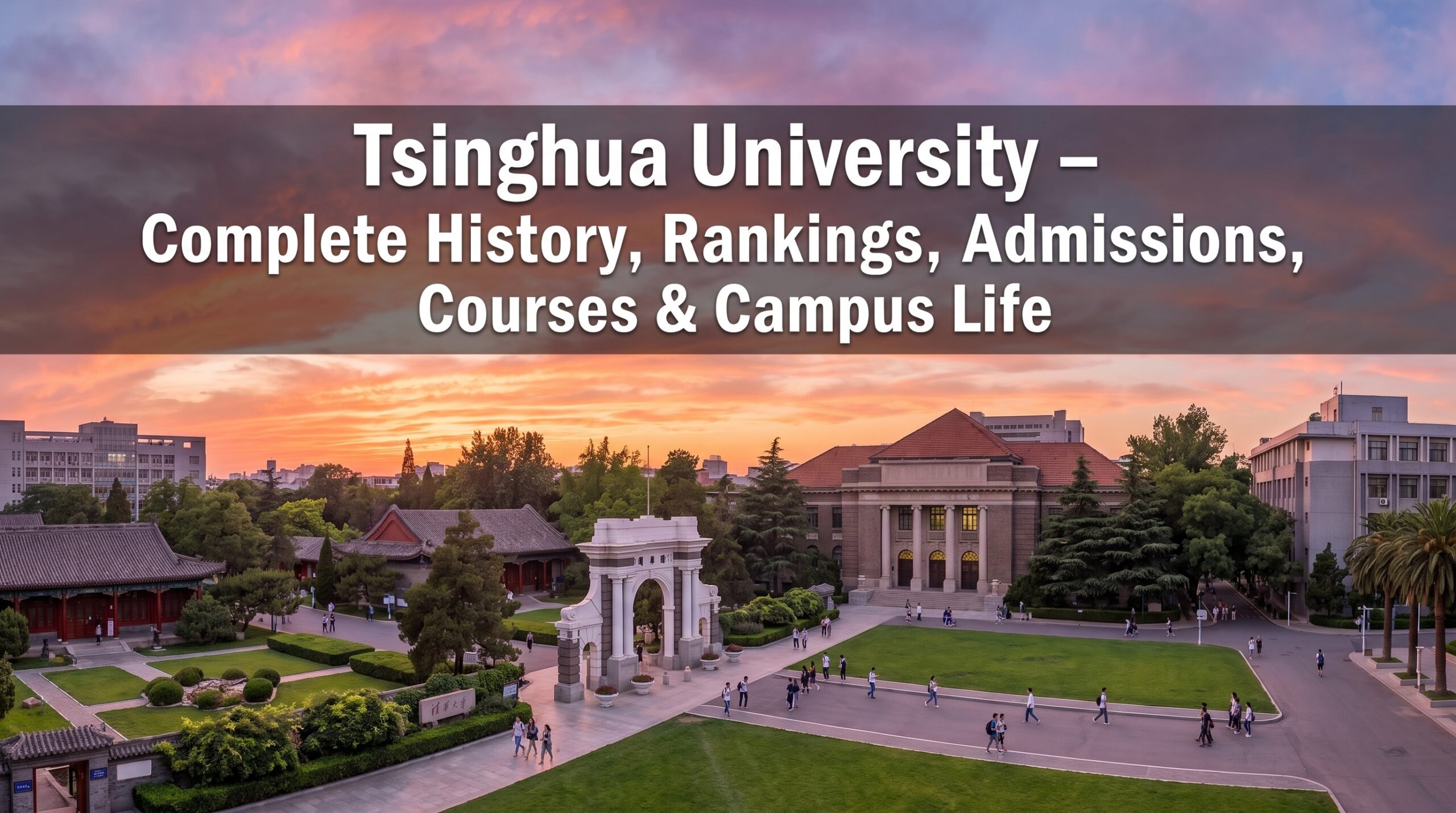
The Tsinghua University campus spans a massive 980 acres (almost 400 hectares) in the Haidian District of Beijing. It is widely regarded as one of the most beautiful university campuses in the world, uniquely blending imperial Chinese landscaping with 20th-century Western institutional architecture and cutting-edge modern research facilities.
The Imperial Gardens (Tsinghua Yuan)
The western section of the campus is built on the former site of the Tsinghua Garden, a royal estate built during the Qing Dynasty. This area retains classical Chinese architectural elements, featuring weeping willows, lotus ponds, traditional pavilions, and meandering stone pathways. The Jinchun Yuan (Near Spring Garden), featuring a serene lake and a central island, serves as a peaceful retreat for students seeking refuge from the intense academic pressure. The juxtaposition of ancient imperial serenity with the frenetic pace of a modern tech hub is one of Tsinghua’s most defining aesthetic characteristics.
The Old Gate (Er Xiao Men)
The most iconic symbol of Tsinghua University is the Old Gate, a classical, three-arch white stone portal featuring intricate carvings and the characters for “Tsinghua Yuan” inscribed across the top. Built in 1909, it served as the original main entrance to the university. During the tumultuous years of the Cultural Revolution, the gate was destroyed, but it was meticulously reconstructed in 1991 by university alumni. Today, it stands as the spiritual center of the campus, acting as the mandatory backdrop for graduation photos and a monument to the university’s enduring legacy.
The Grand Auditorium and The Main Building
Designed by American architect Henry Murphy in the early 20th century, the Grand Auditorium (Da Liyang) features a prominent copper dome and a classical Romanesque facade, strongly echoing the architecture of the University of Virginia. It represents the American influence on the university’s founding years. In stark contrast, the Main Building, located on the eastern axis of the campus, is a colossal, imposing structure built in the 1950s Soviet architectural style, symbolizing the era when Tsinghua operated strictly as a polytechnic institute.
Tsinghua University Art Museum (TAM)
Opened in 2016, TAM is the largest university museum in China and a masterpiece of modern design. The building seamlessly integrates massive glass facades with traditional stone. It houses an extensive collection of ancient bronzes, ceramics, calligraphy, and textiles, reflecting the university’s modern commitment to the humanities and the preservation of Chinese cultural heritage alongside its scientific pursuits.
Academic Structure and Major Schools
Tsinghua University operates through 21 schools and 59 departments, offering 82 undergraduate programs and well over a hundred master’s and doctoral programs. The academic ecosystem is characterized by ferocious funding, world-class laboratory infrastructure, and a relentless push for innovation.
The Engineering and Science Powerhouses
The core identity of Tsinghua remains rooted in its STEM programs, which consistently rank number one globally, often surpassing MIT and Stanford in specific engineering disciplines depending on the ranking publication. The School of Information Science and Technology (SIST) and the Department of Computer Science and Technology are globally renowned for their output in artificial intelligence, quantum computing, and cybersecurity. The Department of Precision Instrument and the Department of Electronic Engineering drive massive innovations in China’s semiconductor and aerospace industries.
School of Economics and Management (SEM)
Founded in 1984 with the formidable former Chinese Premier Zhu Rongji serving as its founding dean, Tsinghua SEM is the premier business school in Asia. It operates as the ultimate training ground for China’s financial elite and corporate leaders. The school boasts triple-crown accreditation (AACSB, EQUIS, AMBA) and partners heavily with global institutions, offering highly sought-after MBA and Executive MBA programs that bridge the gap between Western financial theory and the unique dynamics of the Chinese socialist market economy.
Schwarzman College
Launched in 2016 and endowed by American billionaire Stephen A. Schwarzman with a monumental $500 million fundraising effort, Schwarzman College represents Tsinghua’s most ambitious global initiative. Housed in a stunning, custom-built facility that blends traditional Chinese courtyards with modern luxury, the program offers a one-year Master’s degree in Global Affairs. Designed to be the 21st-century equivalent of the Rhodes Scholarship, it annually selects around 150 elite scholars from across the globe (with a heavy emphasis on American and Chinese students) to live and study together, fostering profound geopolitical understanding and building the next generation of global leaders.
Xinya College
Established in 2014, Xinya College is Tsinghua’s answer to the Western liberal arts residential college. It represents a radical departure from the hyper-specialized tracks typical of Chinese higher education. Xinya offers a general education core curriculum where students study philosophy, literature, and history for their first year before declaring a major. Students live together in a dedicated residential community that encourages cross-disciplinary dialogue, aiming to produce well-rounded thinkers rather than just highly skilled technicians.
PBC School of Finance
Founded in 2012 as a joint venture between Tsinghua University and the People’s Bank of China (PBC), this graduate school is the absolute pinnacle of financial education in China. Located in the financial district rather than on the main campus, it leverages direct connections with China’s central bank and top regulatory bodies. It trains the policymakers, central bankers, and hedge fund managers who dictate the flow of capital throughout the Chinese economy.
Notable Courses and Signature Academic Programs
The Yao Class (Computer Science)
Officially known as the “Tsinghua Xuetang Computer Science Experimental Class,” the Yao Class was founded in 2005 by Andrew Yao, the only Chinese recipient of the Turing Award (the Nobel Prize of computing). Admission to the Yao Class is arguably the most difficult academic achievement for a high school student in China. It recruits the absolute highest scorers in the national math and physics Olympiads. The curriculum is entirely in English, extraordinarily rigorous, and focuses heavily on theoretical computer science, cryptography, and artificial intelligence. Graduates of the Yao Class are globally recognized and highly coveted by top tech firms and elite Ph.D. programs worldwide.
Tsien Excellence in Education Program (TEEP)
Named after Tsien Hsue-shen (Qian Xuesen), the legendary aerodynamicist and the father of the Chinese space program, this elite undergraduate program is designed to cultivate the next generation of chief scientists and engineering visionaries. The program breaks down traditional disciplinary boundaries, requiring students to master advanced mechanics, mathematics, and systems engineering. It focuses on solving complex, real-world aerospace and heavy-industry problems through hands-on, mentor-led research from the freshman year onward.
The Global Innovation Exchange (GIX)
In a historic partnership with the University of Washington and heavily backed by Microsoft, Tsinghua established the GIX program in Seattle. It represents the first time a Chinese research university has established a physical academic presence in the United States. GIX offers dual master’s degrees in technology innovation, where Tsinghua students collaborate with American peers to develop hardware and software solutions to global challenges, blending Chinese manufacturing speed with American software architecture.
Admissions, Selectivity, and Financial Aid
The Gaokao Crucible: Domestic Admissions
For Chinese citizens, gaining admission to Tsinghua University is the ultimate academic triumph, representing the culmination of years of grueling preparation for the National College Entrance Examination, or *Gaokao*. Tsinghua, alongside its fierce neighbor Peking University, sits at the absolute pinnacle of the Chinese university hierarchy. The selectivity is mathematically staggering.
Each year, over 10 to 12 million students take the Gaokao. Tsinghua admits approximately 3,300 to 3,400 undergraduate students. To secure a spot through the standard Gaokao route, a student must typically score in the top 0.01% to 0.03% of their respective province. In populous provinces like Henan or Shandong, this means being ranked in the top 50 out of over a million test-takers. The pressure is immense; securing admission to Tsinghua often alters the socioeconomic trajectory not just of the student, but of their entire extended family.
Special Recruitment and the “Zhiqiang” Plan
While the Gaokao is the primary route, Tsinghua aggressively recruits the nation’s top mathematical and scientific talent through the Olympiad system. Students who win gold medals in national math, physics, chemistry, and informatics Olympiads are frequently offered conditional early admission or significant point reductions on their Gaokao requirements. Furthermore, recognizing the vast educational disparities between urban centers and rural China, Tsinghua established the “Zhiqiang Plan” (Self-Improvement Plan). This targeted admissions track lowers the entry barriers for exceptionally talented students from impoverished, rural, and mountainous regions, ensuring that the university remains an engine of social mobility.
International Admissions
For international students, the admissions process bypasses the Gaokao and adopts a more holistic, Western-style review process. International applicants are evaluated based on their high school transcripts, standardized test scores (such as the SAT, ACT, IB, or A-Levels), letters of recommendation, and personal essays. While technically less competitive mathematically than the domestic Gaokao route, the international pool is still exceptionally rigorous, drawing top students from across Southeast Asia, Europe, and the Americas.
Financial Aid and Scholarships
Tsinghua is heavily subsidized by the Chinese Ministry of Education. For domestic students, tuition is extraordinarily low compared to Western institutions, typically ranging from 5,000 to 6,000 RMB (roughly $700 – $850 USD) per year, with on-campus dormitory costs equally subsidized. For international students, tuition is higher (around $4,000 to $6,000 USD per year) but remains highly competitive globally. Tsinghua offers an extensive array of financial aid, including the Chinese Government Scholarship (CSC), the Beijing Government Scholarship, and university-specific merit grants, ensuring that financial constraints rarely prevent an admitted student from attending.
University Rankings and Global Reputation
Tsinghua University’s ascent in global university rankings over the past two decades has been nothing short of meteoric. Backed by massive government funding and an unyielding focus on research output, Tsinghua has firmly established itself as a top 20 global institution and the undisputed leader in Asia.
Institutional Rankings (2025–2026)
| Ranking Publication | Global Rank | Asia Rank | National (China) Rank |
|---|---|---|---|
| QS World University Rankings | 14 | 1 (Tie) | 1 |
| Times Higher Education (THE) | 12 | 1 | 1 |
| U.S. News & World Report | 23 | 1 | 1 |
| Academic Ranking of World Universities (ARWU) | 22 | 1 | 1 |
Subject-Specific Dominance
While Tsinghua’s overall rankings are stellar, its dominance in specific subjects is staggering. In the U.S. News & World Report global subject rankings, Tsinghua University is consistently ranked #1 in the world for Engineering, frequently surpassing MIT, Stanford, and Imperial College London. It also holds top 5 global rankings in Computer Science, Materials Science, Chemical Engineering, and Artificial Intelligence research. This immense output is driven by the sheer volume of high-impact research papers published by its faculty and doctoral students.
Campus Life and The Residential Experience
Life at Tsinghua is characterized by a fascinating dichotomy: it is an environment of intense, almost suffocating academic pressure, balanced by a remarkably vibrant, communal, and highly active daily lifestyle.
The Bicycle Culture
The Tsinghua campus is massive. Walking from the undergraduate dormitories in the northeast to the teaching buildings in the south can take over 45 minutes. Consequently, the entire campus operates on two wheels. Bicycles and e-bikes are an absolute necessity. During the ten-minute transition periods between classes, the campus transforms into a massive, organized swarm of thousands of students cycling frantically along the wide, tree-lined avenues. The “bicycle army” is one of the most iconic and beloved aspects of the Tsinghua experience.
Dormitory Life: Zijing Student Village
Unlike Western universities where students often move off-campus after their freshman year, virtually all Tsinghua undergraduates live on campus for all four years. The vast majority reside in the Zijing (Purple Bauhinia) Student Village, one of the largest student residential complexes in the world. Domestically, students typically live in spartan but functional four-person rooms with bunk beds and shared bathroom facilities. This close-knit living arrangement fosters intense, lifelong bonds among roommates, who operate as a micro-family unit navigating the rigors of university life together.
The Canteens (Dining Halls)
Tsinghua is famous across China for the scale, affordability, and quality of its dining halls. With over 15 massive canteens spread across the campus, the university essentially functions as a culinary tour of China. The Qingfen and Ziyijing canteens are legendary. Because Tsinghua draws students from every province in the nation, the dining halls offer authentic, regional cuisines—from spicy Sichuan hotpot and Shaanxi noodles to delicate Cantonese dim sum and Xinjiang roast lamb. Meals are heavily subsidized by the university, allowing students to eat exceptionally well for just a few dollars a day.
Student Culture, Extracurriculars, and Traditions
The academic burden at Tsinghua is notoriously heavy, yet students maintain a fierce dedication to extracurricular involvement, viewing it as a necessary outlet and a crucial component of their holistic development.
“Without Sports, There is No Tsinghua”
Athletics are deeply woven into the DNA of the university. This ethos was championed by Ma John (John Ma), the legendary director of physical education who worked at Tsinghua for over 50 years. He coined the university’s unofficial physical mantra: “Work healthily for the motherland for 50 years.”
Physical education is a mandatory requirement for graduation, and uniquely, every Tsinghua undergraduate must pass a 3,000-meter running test (for men) or a 1,500-meter test (for women) and demonstrate proficiency in swimming before they are allowed to receive their degree. The late-afternoon scene at the West Sports Ground, packed with thousands of students jogging, playing basketball, or practicing martial arts, is a testament to this enduring culture.
Student Unions and Clubs
The Tsinghua University Student Union is a massive, highly organized body that wields significant influence on campus life. Serving in the union is often viewed as a stepping stone for future political and administrative leadership in China. Beyond the union, there are over 250 registered student associations ranging from the hardcore (The Artificial Intelligence Society, The Aerospace Innovation Club) to the cultural (The Peking Opera Society, The Debate Team) and the recreational (The Mountaineering Team, which has an illustrious history of conquering major Himalayan peaks).
The Tsinghua-Peking University Rivalry
Located just a few hundred meters away from Tsinghua is Peking University (Beida). The dynamic between the two institutions mirrors the Oxford-Cambridge or MIT-Harvard rivalries. While Tsinghua is traditionally viewed as the pragmatic, stoic, engineering powerhouse, Beida is seen as the romantic, liberal, humanities-focused institution. This rivalry plays out fiercely in annual rowing regattas on the Kunming Lake, basketball tournaments, and good-natured academic banter.
Notable Alumni and Faculty Legacy
The output of human capital from Tsinghua University is unparalleled in modern China. Its alumni network forms the backbone of the Chinese political, scientific, and corporate establishment.
Political Leadership
Tsinghua is famously known as the “cradle of politicians.” Its engineering-focused graduates have dominated the highest echelons of the Chinese Communist Party. Current Chinese President and General Secretary Xi Jinping is a Tsinghua alumnus, having studied chemical engineering. His predecessor, former President Hu Jintao, graduated from Tsinghua’s Department of Water Conservancy Engineering. Former Premier Zhu Rongji, the architect of China’s modern economic miracle, was a graduate of the electrical engineering department and later the founding dean of the School of Economics and Management.
Scientific Pioneers and Nobel Laureates
The university’s scientific legacy is monumental. While operating in exile as Lianda during WWII, the institution educated Chen-Ning Yang and Tsung-Dao Lee, who would go on to win the Nobel Prize in Physics in 1957. Renowned modern scientists include Shi Yigong, a world-leading structural biologist who returned to Tsinghua from Princeton to revolutionize Chinese life sciences, and Andrew Yao, the Turing Award winner who established the legendary Yao Class.
Business Titans and Innovators
Tsinghua alumni have founded and lead some of China’s most powerful technology and corporate giants. Notable business figures include Wang Xing (founder of Meituan, China’s massive food delivery and local services platform), Zhang Chaoyang (founder of Sohu), and numerous executives across Tencent, Alibaba, and Baidu. The university operates as a direct pipeline to the entrepreneurial ecosystem of the surrounding Haidian district.
Tsinghua and the Haidian District (Zhongguancun)
Tsinghua University cannot be viewed in isolation from its immediate geographical context: the Haidian District, and specifically, Zhongguancun. Often referred to as “China’s Silicon Valley,” Zhongguancun is a massive technology hub located directly adjacent to the Tsinghua campus.
This symbiotic relationship between the university and the tech hub drives a massive engine of innovation. Tsinghua acts as the primary research and development incubator for the district. The university operates the Tsinghua Science Park (TusPark), which houses hundreds of startups founded by professors and students, as well as the research centers of multinational giants like Google, Microsoft, and Sohu. This proximity allows students to seamlessly transition from cutting-edge theoretical research in campus laboratories to aggressive commercial application in the venture capital-fueled ecosystem just outside the East Gate.
Frequently Asked Questions (FAQ)