Introduction
Today, Johns Hopkins operates as an unparalleled juggernaut of global research, public health, and biomedical engineering. For over four decades consecutively, the university has led all U.S. academic institutions in total research and development spending, frequently exceeding $3 billion annually—a testament to its immense scale and the profound trust placed in it by federal agencies, including the Department of Defense and NASA. The university’s Applied Physics Laboratory (APL) builds spacecraft that touch the sun and explore the outer reaches of the solar system, while its medical researchers pioneer cancer immunotherapies and sequence the human genome.
Yet, to view Johns Hopkins solely as a scientific research facility is a vast underestimation. Its School of Advanced International Studies (SAIS) dictates foreign policy in Washington D.C., and its Peabody Institute nurtures the world’s most brilliant musical prodigies. In the modern era, fueled by unprecedented, multi-billion-dollar philanthropic gifts from alumni such as Michael R. Bloomberg, the university has eradicated financial barriers to education, making its undergraduate programs and world-famous medical school tuition-free for the vast majority of American families. This comprehensive guide details the historical evolution, extraordinary academic ecosystem, breathtaking campuses, and enduring legacy of Johns Hopkins University.
The Comprehensive History of Johns Hopkins University
Philanthropic Beginnings and the Quaker Merchant
The foundation of the university rests entirely on the immense generosity of its namesake, Johns Hopkins. Born in 1795 to a Quaker family in Maryland, Hopkins amassed a massive fortune as a merchant, banker, and primary investor in the Baltimore and Ohio (B&O) Railroad. The unusual first name “Johns” was the maiden name of his great-grandmother, Margaret Johns, a naming tradition that has confused generations of observers (prompting the famous quip that people are constantly trying to “steal the ‘s’ from Johns and add it to Hopkins”).
A lifelong bachelor with no direct heirs, Hopkins witnessed the devastation of cholera and yellow fever epidemics in Baltimore. Upon his death in 1873, he bequeathed $7 million (equivalent to hundreds of millions in today’s currency) in B&O Railroad stock to establish a university and an affiliated hospital in his city. At the time, this was the largest single philanthropic gift in the history of the United States. Hopkins stipulated that the hospital must be directly linked to the university’s medical school to foster the seamless integration of research and patient care, a directive that would ultimately revolutionize global medicine.
Daniel Coit Gilman and the Humboldtian Revolution (1876)
The original board of trustees possessed the foresight to seek out a visionary leader, ultimately hiring Daniel Coit Gilman as the university’s first president. Gilman fundamentally disagreed with the prevailing American educational philosophy. Inaugurated in 1876, he modeled the new university on the German research universities, particularly Heidelberg University (the Humboldtian model). Gilman declared that the university’s primary objective was the “advancement of individual scholars, who by their excellence will advance the sciences they pursue, and the society where they dwell.”
Under Gilman, Johns Hopkins prioritized graduate education and faculty research above all else. He launched the first academic press in America (Johns Hopkins University Press) to disseminate faculty discoveries, established the seminar method of teaching in the U.S., and offered fellowships to attract the brightest graduate minds. This radical approach triggered an arms race in American academia, forcing institutions like Harvard, Yale, and Columbia to frantically develop their own graduate schools and research programs to compete with the upstart university in Baltimore.
The Medical Revolution: The “Big Four”
While the university opened in 1876, the Johns Hopkins Hospital opened in 1889, followed by the School of Medicine in 1893. The founding of the medical school was delayed by financial difficulties, which were famously resolved when a group of wealthy women—including Mary Elizabeth Garrett and M. Carey Thomas—offered to cover the shortfall on one strict condition: the medical school must admit women on the exact same terms as men, and it must require a bachelor’s degree for entry. The university agreed, making it the first major medical school in the U.S. to admit women and to mandate undergraduate prerequisites.
The medical school fundamentally altered the practice of medicine under the leadership of four legendary founding physicians, known as the “Big Four”: William H. Welch (Pathology), William Osler (Medicine), William Stewart Halsted (Surgery), and Howard Atwood Kelly (Gynecology). William Osler invented the modern medical residency system and established the practice of bringing medical students out of the lecture hall and onto the hospital wards to learn directly at the patient’s bedside. William Stewart Halsted pioneered the use of surgical gloves, revolutionized radical mastectomies, and instituted strict, aseptic surgical techniques.
World War II, APL, and Modern Expansion
During the 20th century, Johns Hopkins dramatically expanded its scope. In 1942, amidst the urgency of World War II, the university established the Applied Physics Laboratory (APL) in partnership with the U.S. government. Operating initially in a used-car dealership in Silver Spring, Maryland, APL scientists developed the variable-time (VT) proximity fuze, considered one of the most critical technological innovations of the war, drastically increasing the effectiveness of anti-aircraft artillery. This cemented a permanent, highly secretive, and deeply lucrative relationship between JHU and federal defense and space agencies.
In the modern era, Johns Hopkins has expanded aggressively beyond Baltimore. It established the School of Advanced International Studies (SAIS) in Washington D.C. (1943), a campus in Bologna, Italy (1955), and the Hopkins-Nanjing Center in China (1986). Throughout the late 20th and 21st centuries, fueled by a colossal endowment and unmatched federal grants, the university has maintained an iron grip on its status as the world’s premier research institution.
Campus Architecture and Key Locations
Unlike traditional universities consolidated into a single sprawling campus, Johns Hopkins operates as a deeply decentralized network of campuses spread across Baltimore, the greater Washington D.C. metropolitan area, and international hubs, each possessing a distinct architectural and academic identity.
The Homewood Campus
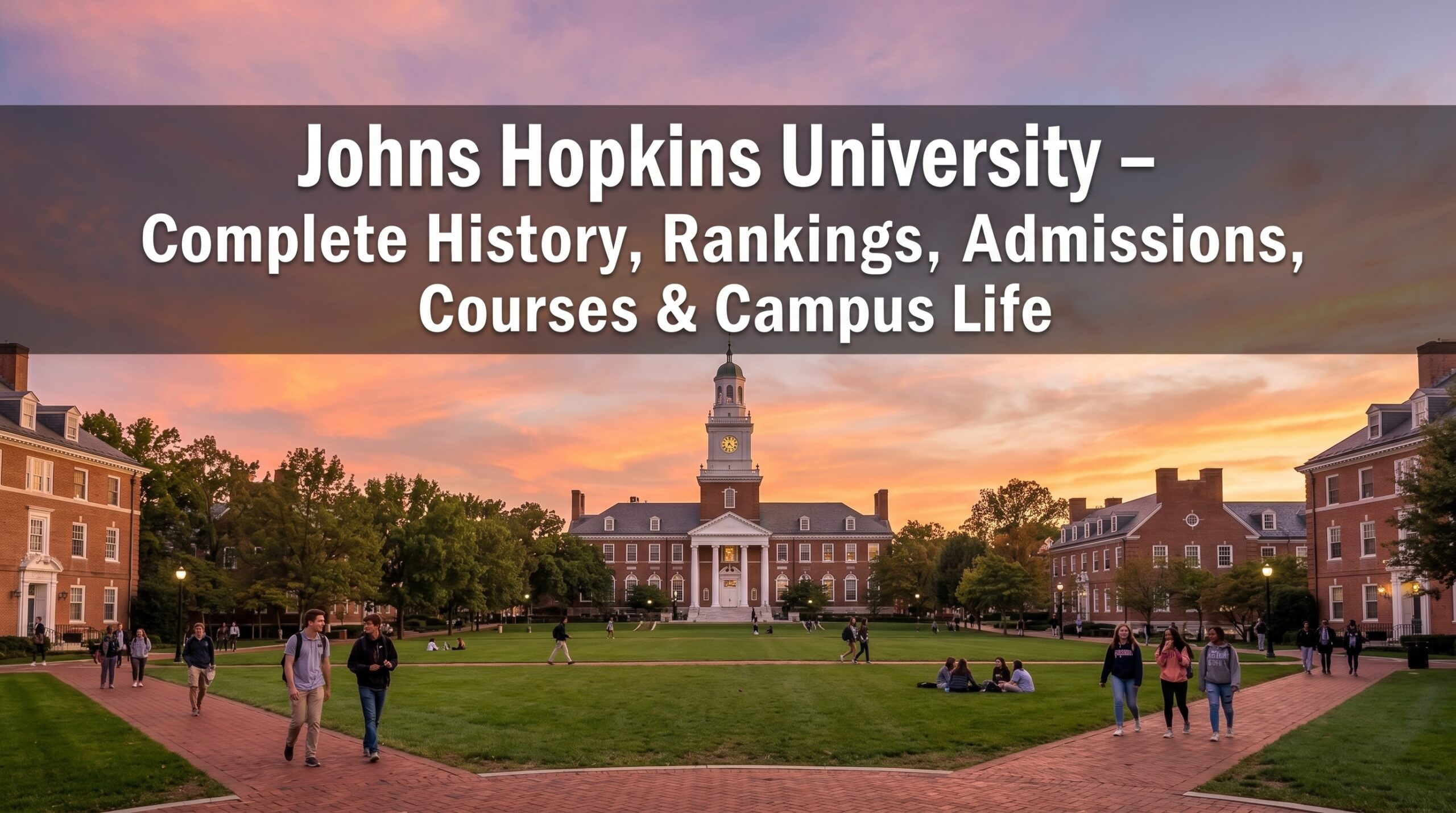
Located in the northern part of Baltimore, the 140-acre Homewood Campus serves as the primary hub for undergraduates, housing the Zanvyl Krieger School of Arts and Sciences and the Whiting School of Engineering. The campus is a stunning example of Federal and Georgian Revival architecture, characterized by uniform red-brick buildings accented with white marble trim and porticos.
The architectural centerpiece is Gilman Hall, distinguished by its iconic clock tower, which houses the humanities departments and a magnificent central atrium. The Milton S. Eisenhower Library (MSEL) is an architectural marvel of a different sort; designed to preserve the aesthetic purity of the academic quad (the “Beach”), the library was constructed largely underground. Visitors enter on the main floor and descend through multiple subterranean levels flooded with natural light from large light wells. The campus is deeply interwoven with the historic Charles Village neighborhood, seamlessly blending academic serenity with urban vibrancy.
The East Baltimore Medical Campus
Situated a few miles southeast of Homewood, the East Baltimore campus is a colossal, high-density urban complex dedicated strictly to medicine, public health, and nursing. It houses the Johns Hopkins Hospital, the School of Medicine, the Bloomberg School of Public Health, and the School of Nursing. The architecture here contrasts the collegiate brick of Homewood with towering glass-and-steel clinical and research mega-structures, notably the Sheikh Zayed Tower and the Charlotte R. Bloomberg Children’s Center, showcasing the immense scale of Hopkins’ biomedical enterprise.
Peabody Institute (Mount Vernon)
Located in the historic, culturally rich Mount Vernon neighborhood of downtown Baltimore, the Peabody Institute is the oldest conservatory in the United States, seamlessly integrated into the JHU ecosystem. Its crown jewel is the George Peabody Library, a breathtaking 19th-century “cathedral of books” featuring a massive skylight and five tiers of ornate cast-iron balconies. It is widely considered one of the most beautiful libraries in the world and serves as a profound testament to the university’s commitment to the arts.
SAIS and The Applied Physics Laboratory (APL)
In Washington, D.C., the School of Advanced International Studies (SAIS) recently consolidated its operations into the Hopkins Bloomberg Center, an ultra-modern, cutting-edge facility located at 555 Pennsylvania Avenue, mere steps from the U.S. Capitol, placing JHU students at the literal epicenter of global policymaking.
The Applied Physics Laboratory (APL) is located in Laurel, Maryland. Operating as a massive, 400-acre highly secure research campus, APL functions essentially as a miniature NASA or DARPA. It is entirely restricted to cleared personnel and is responsible for designing and managing monumental space exploration missions, including the Parker Solar Probe and the New Horizons mission to Pluto.
Academic Structure and Major Schools
Johns Hopkins University is composed of nine distinct academic divisions. The university’s decentralized structure grants each school immense autonomy, allowing them to operate as elite, specialized powerhouses within their respective fields.
Zanvyl Krieger School of Arts and Sciences
Based on the Homewood campus, the Krieger School is the core institution for undergraduate and graduate education in the humanities, social sciences, and natural sciences. It heavily emphasizes the integration of undergraduates into advanced research. The school is globally renowned for its departments of History, English, Political Science, and the elite Writing Seminars—one of the premier creative writing programs in the nation.
Whiting School of Engineering
Sharing the Homewood campus with Krieger, the Whiting School of Engineering is a titan of applied sciences. It is most famous for its Department of Biomedical Engineering (BME), which is consistently ranked as the #1 BME program in the United States by virtually every major publication. Whiting heavily emphasizes “design thinking,” requiring undergraduates to form design teams to solve complex, real-world clinical and structural problems posed by industry partners and JHU medical faculty.
Bloomberg School of Public Health
Founded in 1916, it is the oldest and largest school of public health in the world. It has been ranked #1 by U.S. News & World Report every single year since the rankings began in 1994. The Bloomberg School dictates global health policy, operating massive research initiatives in epidemiology, infectious diseases, gun violence prevention, and global health systems. During the COVID-19 pandemic, the school’s Coronavirus Resource Center became the definitive global dashboard for tracking global infection and mortality data.
Johns Hopkins School of Medicine
Consistently ranking among the top three medical schools in the United States (alongside Harvard and Penn), the School of Medicine is the gold standard for clinical training and biomedical research. The school pioneered modern medical education and continues to push the boundaries of genomics, neurology, and oncology. Admission is notoriously selective, typically hovering around an acceptance rate of just 3-5%.
School of Advanced International Studies (SAIS)
SAIS is one of the world’s premier graduate schools for international relations, economics, and diplomacy. With campuses in Washington, D.C., Bologna, and Nanjing, it offers a uniquely global perspective. Its alumni heavily populate the U.S. State Department, the World Bank, the IMF, and international intelligence agencies. The curriculum is famous for its grueling quantitative economics requirement, ensuring its diplomats are as fluent in macroeconomic policy as they are in geopolitical theory.
Carey Business School & School of Education
The Carey Business School, while younger than its Ivy League counterparts, operates with a unique, modernized focus on the business of healthcare, enterprise risk management, and commercial real estate, leveraging the university’s biomedical dominance. The School of Education is consistently ranked among the top 15 in the nation, specializing in education policy, urban education reform, and counseling.
Peabody Institute & School of Nursing
The Peabody Institute functions as an elite, conservatory-style music and dance school, accepting world-class prodigies in orchestral performance, composition, and conducting. The Johns Hopkins School of Nursing is perpetually ranked as the #1 graduate nursing program in the United States, pioneering advanced clinical practice and nursing leadership on a global scale.
Notable Courses and Signature Academic Programs
Biomedical Engineering (BME) and The Design Team
The undergraduate Biomedical Engineering program at Johns Hopkins is legendary. The program is heavily restricted; applicants must specifically apply to the BME major during the admissions process, and acceptance is fiercely competitive. A hallmark of the BME experience is the “Design Team” sequence. From their freshman year, undergraduates are grouped with clinical physicians from the School of Medicine to design, prototype, and patent medical devices that solve immediate, real-world surgical or therapeutic challenges. Dozens of these student-led projects have been commercialized or licensed by major medical device corporations.
The Pre-Medical Track and Outcomes
While JHU offers over 50 different majors, it is globally famous (and occasionally infamous) for its pre-medical track. The coursework is intentionally punishing, designed to ruthlessly prepare students for the MCAT and the rigors of medical school. Courses like Organic Chemistry, Biochemistry, and Physics operate at an elite level of difficulty. However, the outcomes justify the rigor; Johns Hopkins undergraduates who apply to medical school boast an acceptance rate that regularly exceeds 80%, roughly double the national average. The proximity to the JHU Medical campus allows undergraduates to easily secure clinical shadowing and laboratory research positions that are unmatched elsewhere.
Provost’s Undergraduate Research Awards (PURA)
True to its heritage as America’s first research university, Johns Hopkins fundamentally believes that undergraduates should generate new knowledge, not just consume it. The PURA program provides substantial financial grants to undergraduates across all disciplines—from poetry to quantum physics—to conduct independent research over the summer or during the academic year. Students present their findings at a university-wide symposium, and many are subsequently published in peer-reviewed academic journals before they even receive their bachelor’s degrees.
Admissions, Selectivity, and Historic Financial Aid
The Undergraduate Admissions Landscape (2025–2026 Data)
Securing admission to Johns Hopkins University has become one of the most formidable challenges in American higher education. The university has experienced a staggering surge in applications over the past decade, driven by its expanding national profile, its dominance in STEM fields, and historic enhancements to its financial aid programs.
For the Class of 2029 (entering in Fall 2025), Johns Hopkins received an astounding 49,112 applications. The university admitted just 2,525 students, resulting in a record-low overall acceptance rate of 5.14%. This places JHU’s selectivity firmly in the exact same territory as Ivy League institutions like Penn, Brown, and Cornell. For the Class of 2030 (entering Fall 2026), the university continued this highly restrictive trend, admitting students from an incredibly competitive, global applicant pool.
JHU operates two binding early application rounds: Early Decision I (EDI) and Early Decision II (EDII). Strategically, applying Early Decision offers a significant mathematical advantage; the ED acceptance rate historically hovers around 10% to 11%, roughly double the brutal Regular Decision rate. The admissions committee heavily values deep, sustained engagement in research, high-impact community leadership, and profound intellectual curiosity.
Furthermore, beginning with the Class of 2030, Johns Hopkins permanently ended its temporary test-optional policy, reinstating the requirement for applicants to submit SAT or ACT scores. The academic profile of admitted students is flawless, with the middle 50% of enrolled students boasting SAT scores ranging from 1530 to 1560, and ACT scores tightly clustered between 34 and 36.
The Bloomberg Factor: Historic Tuition-Free Policies
Johns Hopkins currently offers some of the most generous, aggressive financial aid packages in the history of global higher education, funded largely by its most famous alumnus, former New York City Mayor Michael R. Bloomberg. Over the past decade, Bloomberg Philanthropies has donated over $4.5 billion to the university, radically altering its accessibility.
In November 2025, the university announced a monumental enhancement to its undergraduate financial aid: Johns Hopkins is now entirely tuition-free for all undergraduates whose families earn up to $200,000 per year. Furthermore, for families earning up to $100,000, the university assesses a $0 parent contribution, providing additional grant aid to cover living expenses, room, board, and fees. This policy means that students representing over 85% of American households can attend JHU without paying tuition, completely free from the burden of student loans.
This immense philanthropic vision also extends to the graduate level. In July 2024, Bloomberg announced an unprecedented $1 billion gift dedicated exclusively to the School of Medicine. Under this initiative, medical school tuition is completely free for students whose families earn less than $300,000 annually, and all living expenses are covered for medical students from families earning under $175,000. This gift addresses the national crisis of medical student debt and empowers JHU graduates to pursue critical, lower-paying specialties like primary care and pediatrics rather than being forced into lucrative specialties solely to service loans.
Institutional Rankings and Global Reputation
Johns Hopkins is a permanent fixture in the highest echelons of global academic rankings, bolstered by its unmatched research expenditures, elite faculty, and supreme dominance in the health sciences.
Institutional Rankings (2025–2026)
| Ranking Publication | Global Rank | National (US) Rank |
|---|---|---|
| U.S. News & World Report | 13 | 6 |
| Times Higher Education (THE) | 15 | 11 |
| QS World University Rankings | 32 | – |
| Academic Ranking of World Universities (ARWU) | 16 | 13 |
| Center for World University Rankings (CWUR) | 12 | 10 |
Subject-Specific Dominance
Beyond broad institutional scores, Johns Hopkins commands absolute supremacy in specific disciplines. The Bloomberg School of Public Health has been ranked #1 in the U.S. for over three decades. The Biomedical Engineering program (both undergraduate and graduate) consistently ranks #1 nationwide. The School of Nursing and the School of Medicine (particularly in Internal Medicine, Surgery, and Radiology) are universally ranked in the top 3 globally. Furthermore, SAIS routinely ranks within the top 5 globally for international relations and foreign policy programs.
Campus Life and Extracurricular Traditions
The student experience at Johns Hopkins is defined by a culture of intense intellectual rigor, balanced by vibrant campus traditions and a profound connection to the city of Baltimore.
The Culture of Research and “Hopkins Hustle”
The defining cultural trait of the Hopkins student body is an aggressive, proactive ambition often colloquially referred to as the “Hopkins Hustle.” Students do not wait for opportunities to be handed to them; they cold-email principal investigators, design non-profit startups, and aggressively pursue shadowing hours at the hospital. While the environment is highly competitive, it is famously collaborative rather than cutthroat. Study groups are a necessity to survive the legendary organic chemistry curves, and upperclassmen routinely mentor freshmen on research methodologies.
Spring Fair and Lighting of the Quads
To alleviate the intense academic pressure, JHU hosts several massive campus traditions. The Spring Fair, held every April, is widely considered the largest student-run festival in the United States. Spanning a three-day weekend, the Homewood campus transforms into a massive carnival featuring food trucks from across the Mid-Atlantic, beer gardens, artisan vendor tents, and a massive headline concert (past acts have included The Chainsmokers, Steve Aoki, and Meek Mill).
In the winter, the Lighting of the Quads signals the end of the fall semester. Thousands of students gather in front of Gilman Hall for a massive countdown, illuminating the Georgian architecture with tens of thousands of holiday lights, accompanied by fireworks, a cappella performances, and hot apple cider.
Blue Jay Athletics and The Lacrosse Dynasty
The athletic profile of Johns Hopkins is highly unique. The university fields 24 varsity teams known as the Blue Jays. While 22 of these teams compete in the NCAA Division III Centennial Conference, the Men’s and Women’s Lacrosse teams compete in NCAA Division I (as affiliate members of the Big Ten Conference). Lacrosse is practically a religion at JHU. The Men’s Lacrosse team has won an astonishing 44 national championships, representing one of the most dominant athletic dynasties in American sports history. The legendary Homewood Field serves as the Mecca of college lacrosse, and the annual rivalry games against the University of Maryland and Syracuse University draw massive, raucous crowds that serve as the pinnacle of school spirit.
Notable Alumni and Faculty Legacy
The human output of Johns Hopkins University has fundamentally altered the trajectory of modern science, literature, and global governance. As of the 2020s, 39 Nobel Laureates have been affiliated with the university as alumni or faculty members.
Medicine, Science, and Technology
JHU scientists have decoded the mysteries of the universe and the human body. Alumni and faculty include Peter Agre (Nobel Prize in Chemistry for discovering aquaporins), Carol Greider (Nobel Prize in Medicine for discovering telomerase), and Hamilton O. Smith (Nobel Prize for discovering restriction enzymes, essential for genetic engineering). Harvey Cushing, the father of modern neurosurgery, and Johns Hopkins engineers pioneered cardiopulmonary resuscitation (CPR) and the implantable defibrillator.
Politics, Humanities, and The Arts
The university’s influence extends far beyond the laboratory. Woodrow Wilson, the 28th President of the United States, earned his Ph.D. in history and political science from JHU, making him the only U.S. president to hold a doctorate. Michael R. Bloomberg, billionaire founder of Bloomberg L.P. and former Mayor of New York City, graduated in 1964 with a degree in electrical engineering. The groundbreaking philosopher and educational reformer John Dewey earned his doctorate at Hopkins. In the literary and cinematic arts, legendary author and environmentalist Rachel Carson (author of Silent Spring), acclaimed novelist Chimamanda Ngozi Adichie, and horror cinema mastermind Wes Craven all hold degrees from the university.
Records & Achievements
- First Research University: Founded in 1876 as the first university in the United States explicitly dedicated to research and graduate education.
- #1 in R&D Spending: Has led all U.S. universities in total research and development expenditure for over 40 consecutive years.
- Medical Pioneers: First major U.S. medical school to admit women on an equal basis with men (1893) and the birthplace of the modern medical residency system.
- Space Exploration: The Applied Physics Laboratory (APL) designed and manages the New Horizons mission (first spacecraft to explore Pluto) and the Parker Solar Probe.
- Lacrosse Dominance: The Men’s Lacrosse team has secured 44 national championships.
- Historic Financial Aid: The first major university to announce completely free medical school tuition for the vast majority of applicants (under $300k income) and free undergraduate tuition for families earning up to $200k, thanks to over $4.5 billion in donations from Mike Bloomberg.
Frequently Asked Questions (FAQ)