Introduction
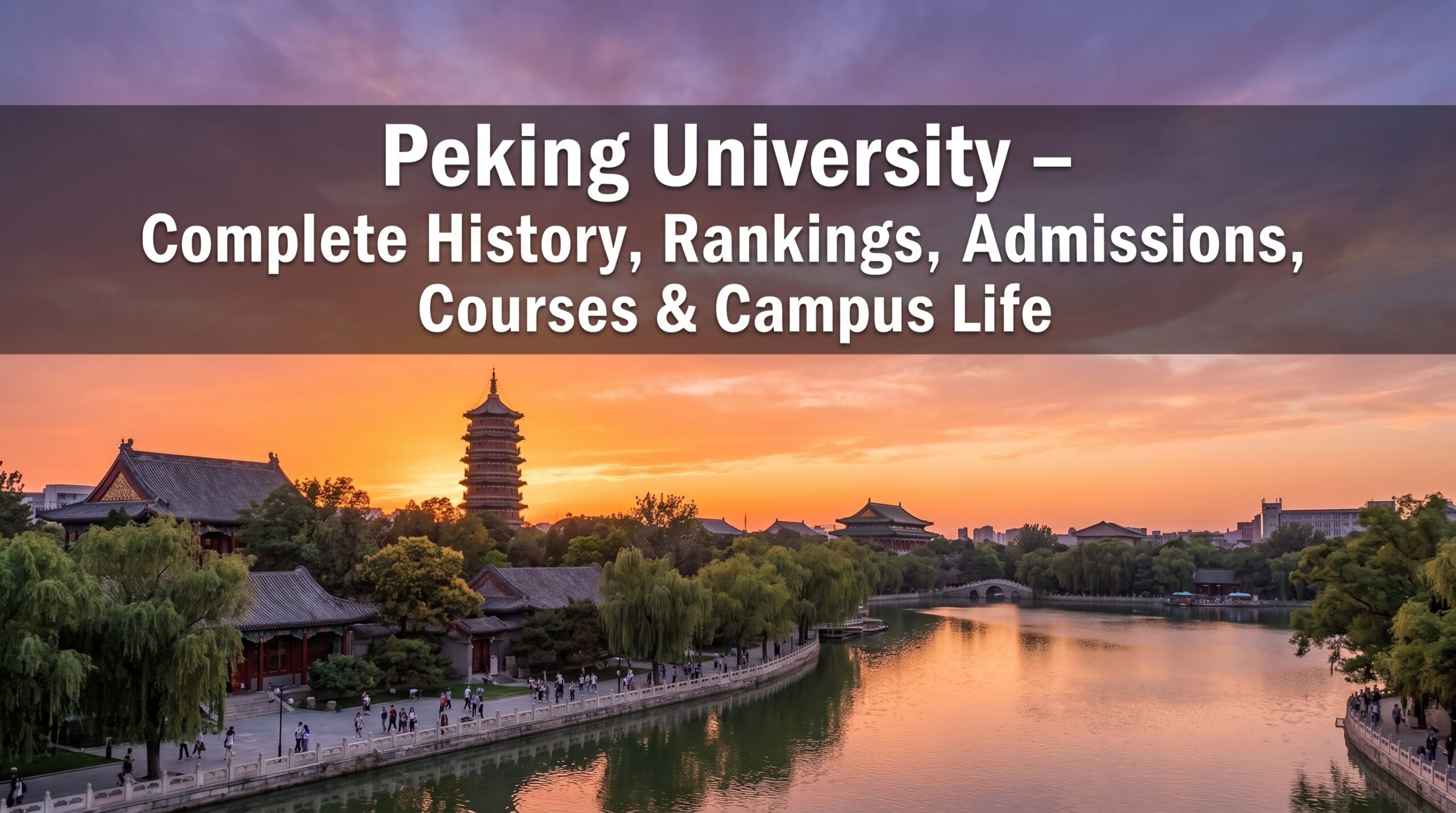
Situated in the Haidian District of northwestern Beijing, the university’s main campus, known as Yanyuan (the Garden of Yan), is globally renowned for its breathtaking classical Chinese landscaping. Built upon the former royal gardens of the Qing Dynasty and the historic campus of Yenching University, it features traditional pagodas, weeping willows, sweeping stone bridges, and tranquil lakes juxtaposed against state-of-the-art quantum physics laboratories and towering libraries. This physical environment perfectly mirrors the university’s academic philosophy: a profound, unwavering respect for Chinese historical tradition combined with a ferocious, forward-looking commitment to global scientific and social innovation.
To examine the Peking University career of an admitted student is to witness the forging of China’s future leadership. As a perennial powerhouse in global rankings, consistently sitting within the top 15 universities worldwide, Beida operates alongside its fierce rival, Tsinghua University, at the absolute apex of the Asian academic hierarchy. While Tsinghua is traditionally recognized for its engineering dominance, Peking University is universally celebrated as the unparalleled master of the humanities, fundamental sciences, medicine, and social sciences. This comprehensive guide delves into the monumental history, grueling admissions standards, vibrant campus culture, and enduring global legacy of China’s most romanticized and revolutionary university.
The Comprehensive History of Peking University
Origins: The Hundred Days’ Reform (1898)
The origins of Peking University are intrinsically tied to one of the most desperate and pivotal moments in Chinese history. Following China’s humiliating defeat in the First Sino-Japanese War, a group of progressive intellectuals and scholars, including Kang Youwei and Liang Qichao, convinced the young Guangxu Emperor that radical modernization was the only way to save the Qing Empire from collapse. This led to the Hundred Days’ Reform in 1898. As part of this sweeping modernization effort, the “Imperial University of Peking” (Jingshi Daxuetang) was established to replace the ancient Guozijian (Imperial College) as the nation’s highest educational administration and research institute.
The reform movement was violently crushed by conservative forces led by Empress Dowager Cixi, who placed the Emperor under house arrest and executed several prominent reformers. However, the Imperial University of Peking was the only major reform allowed to survive the conservative purge. It formally opened its doors, tasked with blending traditional Confucian scholarship with Western sciences, mathematics, and foreign languages. Following the Xinhai Revolution of 1911 and the establishment of the Republic of China, the institution was officially renamed National Peking University in 1912.
The Cai Yuanpei Era and the May Fourth Movement (1919)
The true spiritual birth of the modern Peking University occurred in 1916 with the appointment of Cai Yuanpei as Chancellor. A brilliant scholar who had studied in Germany and France, Cai brought the Western concept of academic freedom to Beijing. He radically transformed the university from a bureaucratic training ground for government officials into a vibrant, fiercely independent center of intellectual inquiry. Cai instituted the principle of “Freedom of Thought, Inclusiveness,” deliberately hiring scholars from across the entire political and philosophical spectrum, regardless of their background.
Under Cai’s leadership, Beida became the epicenter of the New Culture Movement, attracting revolutionary thinkers like Chen Duxiu, Hu Shi, Li Dazhao, and Lu Xun. On May 4, 1919, deeply angered by the betrayal of China at the Treaty of Versailles, thousands of Peking University students marched to Tiananmen Square in mass protest. This event, forever known as the May Fourth Movement, catalyzed a nationwide awakening, heavily influencing the trajectory of Chinese political history and establishing Peking University as the eternal vanguard of Chinese student activism and patriotic reform.
The Sino-Japanese War and Lianda (1937–1946)
The outbreak of the Second Sino-Japanese War in 1937 forced Peking University into a dramatic fight for survival. As Japanese forces occupied Beijing, the university, alongside Tsinghua University and Nankai University, evacuated south to Changsha, and subsequently to Kunming in Yunnan Province. There, the three institutions merged to form the National Southwestern Associated University, famously known as “Lianda.”
Operating in exile for eight years, Lianda existed in conditions of extreme poverty and constant danger from aerial bombardment. Students and professors lived in mud-brick dormitories and subsisted on meager rations. Despite these catastrophic conditions, the intellectual output of Lianda was miraculous, producing two Nobel laureates and hundreds of world-class scientists and humanists. The Lianda era forged an unbreakable bond of resilience and academic purity that remains deeply embedded in the Beida identity today.
1952 Restructuring and the Move to Yanyuan
Following the establishment of the People’s Republic of China in 1949, the nation’s higher education system underwent a massive, Soviet-style restructuring in 1952. The goal was to create highly specialized institutions rather than broad liberal arts universities. During this systemic upheaval, Peking University lost its engineering programs to Tsinghua University but absorbed the elite humanities, pure sciences, and social science faculties from Tsinghua and the American-founded Yenching University.
Consequently, Yenching University was officially dissolved, and Peking University relocated from its original, iconic “Red Building” in central Beijing (near the Forbidden City) to the breathtaking Yenching campus in the northwestern suburbs. This new campus, known as Yanyuan (the Garden of Yan), featured magnificent traditional Chinese architecture designed by American architect Henry K. Murphy. This geographic shift fundamentally altered the physical identity of Beida, placing it in the idyllic setting it occupies today.
Modern Era: Project 985 and Global Integration
In the late 20th and early 21st centuries, Peking University entered an era of rapid modernization and massive government investment. In May 1998, celebrating the university’s 100th anniversary, the Chinese government launched “Project 985,” a monumental funding initiative designed to elevate a select group of Chinese universities to world-class status. Beida was the primary beneficiary of this initiative.
Today, Peking University has aggressively pursued global integration, establishing vast international research partnerships, recruiting Nobel-level faculty from around the world, and founding deeply influential global initiatives like the Yenching Academy. It stands not only as the guardian of traditional Chinese culture but as a cutting-edge powerhouse in genomics, artificial intelligence, and global economics.
Campus Architecture and Landmarks
The Peking University campus, Yanyuan, is consistently ranked as one of the most beautiful university campuses on earth. It occupies 274 hectares in the Haidian District and is characterized by its seamless blending of imperial Qing Dynasty landscaping, classic Chinese palatial architecture, and highly advanced modern research infrastructure.
Weiming Lake and the Boya Pagoda
The absolute spiritual and geographic center of the campus is defined by the phrase “One Mountain, One Lake, One Pagoda.” The lake is the Weiming Lake (Lake of No Name), a serene, weeping-willow-lined body of water that once served as a royal garden for a Qing Dynasty minister. It is the social heart of Beida, where students read philosophy on the grassy banks in the spring and ice skate across its frozen surface in the harsh Beijing winter.
Rising majestically on the southeastern shore of Weiming Lake is the Boya Pagoda. Although it appears to be an ancient Liao Dynasty Buddhist pagoda, it was actually constructed in 1924 as a water tower to supply the Yenching University campus. Designed to harmonize perfectly with the traditional Chinese aesthetics of the landscape, the reflection of the Boya Pagoda on the surface of Weiming Lake is the most iconic, romanticized image associated with Peking University.
The West Gate (Alumni Gate)
The West Gate of Peking University is a magnificent, classical Chinese portal featuring vibrant red doors, sweeping golden eaves, and fierce stone guardian lions. Originally built as the main entrance to Yenching University, it perfectly encapsulates the imperial grandeur of the campus architecture. Above the archway hangs a traditional wooden plaque bearing the four Chinese characters for “Peking University” (Beijing Daxue), famously calligraphed by Mao Zedong in 1950. The West Gate is a site of immense pride and serves as the mandatory backdrop for the graduation photographs of every Beida student.
Peking University Library
The Peking University Library is the largest university library in Asia and one of the most important repositories of Chinese literature and historical documents in the world. With a collection exceeding 8 million volumes, it houses rare ancient manuscripts, bronze rubbings, and unique revolutionary archives. The library itself holds profound historical significance; during the early 20th century, Li Dazhao served as the head librarian, and a young Mao Zedong worked there as a library assistant, reading Marxist texts that would ultimately alter the course of global history.
Arthur M. Sackler Museum of Art and Archaeology
Situated within the campus, the Arthur M. Sackler Museum of Art and Archaeology was the first modern teaching museum built in a Chinese university. Opened in 1993, the museum houses breathtaking collections of ancient Chinese artifacts, ranging from Paleolithic stone tools to Shang Dynasty bronzes and Ming Dynasty ceramics. It serves as a vital teaching laboratory for Beida’s world-renowned archaeology and history departments.
Academic Structure and Major Schools
Peking University operates as a massive, deeply interconnected academic ecosystem, comprising 31 colleges and 14 departments, alongside numerous cutting-edge research institutes. The university offers 125 undergraduate programs, 284 master’s programs, and 258 doctoral programs, covering virtually every spectrum of human knowledge.
The Humanities and Social Sciences Core
The historical prestige of Peking University rests firmly on its absolute dominance in the humanities and social sciences. The Department of Chinese Language and Literature, the Department of History, and the Department of Philosophy are considered the sacred guardians of Chinese intellectual tradition. For over a century, these departments have dictated the evolution of Chinese literary criticism, archaeological discovery, and sociopolitical theory. Admission to these faculties is highly coveted by the nation’s most brilliant literary minds.
Faculty of Science and Engineering
While historically overshadowed in engineering by Tsinghua, Peking University’s Faculty of Science is virtually peerless in basic, fundamental research. The School of Mathematical Sciences and the School of Physics are globally renowned for their theoretical output, frequently placing students in top-tier Ph.D. programs globally. In recent years, Beida has aggressively expanded its applied sciences and engineering footprint, particularly in the College of Engineering, focusing heavily on nanotechnology, materials science, and biomedical engineering to meet modern industrial demands.
Guanghua School of Management
The Guanghua School of Management is arguably the most prestigious business school in China. Founded in 1985 with the renowned economist Li Yining as its guiding force, Guanghua has played a pivotal role in drafting the economic policies that fueled China’s transition to a socialist market economy. The school attracts the absolute highest-scoring Gaokao students in the country. It offers elite MBA and EMBA programs that bridge rigorous quantitative financial theory with the unique, complex regulatory environment of the Chinese corporate landscape.
Peking University Health Science Center (PKUHSC)
In 2000, Beijing Medical University merged with Peking University to form the Peking University Health Science Center. Located a short distance from the main Yanyuan campus, PKUHSC is the premier medical research and training institution in China. It operates several of the country’s top-ranked affiliated hospitals and leads the nation in clinical medicine, pharmacology, and public health research. The integration of PKUHSC allowed Beida to vastly expand its biomedical research capabilities, leading to groundbreaking discoveries in genomics and epidemiology.
Yenching Academy
Established in 2014, the Yenching Academy is Peking University’s flagship global initiative, designed to rival elite Western scholarships like the Rhodes or Marshall. It offers a fully-funded Master’s program in China Studies to a highly selective, diverse cohort of international and domestic scholars. Housed in meticulously restored traditional courtyards in the heart of the campus, the program aims to cultivate a new generation of global leaders who possess a profound, nuanced understanding of China’s history, economy, and geopolitical strategy.
Yuanpei College
Named after the legendary Chancellor Cai Yuanpei, Yuanpei College is an elite, experimental undergraduate college that represents a radical departure from traditional Chinese higher education. Instead of forcing students to declare a hyper-specialized major upon entry, Yuanpei College offers a Western-style liberal arts curriculum. Students are encouraged to explore diverse academic disciplines for their first two years before declaring a major, allowing for highly individualized, interdisciplinary education that fosters innovative, well-rounded thinkers.
Notable Courses and Signature Academic Programs
The Core Curriculum and General Education
Peking University has been at the forefront of reforming undergraduate education in China by heavily promoting a broad, general education core curriculum. Regardless of their specific major, all undergraduates are required to complete rigorous coursework across diverse fields, including Chinese history and culture, philosophical reasoning, quantitative sciences, and global perspectives. This system ensures that a physics prodigy graduates with a profound understanding of classical Chinese poetry, and a literature major possesses a firm grasp of basic statistical analysis.
The Boya Plan and Elite Talent Cultivation
To identify and cultivate the most exceptional academic talent in the country, Peking University utilizes the “Boya Plan” (Boya Talent Cultivation Plan). This program targets students who demonstrate extraordinary potential in basic disciplines like mathematics, physics, chemistry, biology, and the humanities. Admitted students are placed in specialized, fast-tracked academic cohorts, granted early access to graduate-level laboratories, and paired with elite faculty mentors to accelerate their transition into world-class researchers.
Global Joint Degree Programs
Recognizing the necessity of global academic integration, Beida has established highly prestigious joint degree programs with top-tier international universities. The university offers dual-degree undergraduate and master’s programs with institutions like the London School of Economics (LSE), Sciences Po in France, and the National University of Singapore (NUS). These programs require students to split their academic careers between Beijing and the partner institution, fostering a deeply globalized perspective and producing graduates highly coveted by multinational corporations and international NGOs.
Admissions, Selectivity, and Financial Aid
The Gaokao Crucible
For domestic Chinese students, securing admission to Peking University requires conquering the National College Entrance Examination, or *Gaokao*, with almost flawless precision. Beida represents the absolute summit of academic achievement in China. Out of the more than 10 to 12 million students who take the Gaokao annually, Peking University typically admits only about 3,000 undergraduates.
To gain entry through the standard Gaokao route, a student must generally score in the top 0.01% to 0.03% of all test-takers in their respective province. In highly populated provinces, this translates to being ranked in the top 30 to 50 out of over a million students. The pressure to achieve this is immense, as a degree from Beida practically guarantees elite employment, immense societal prestige, and entry into the nation’s most powerful alumni network.
Olympiad Recruitment and Special Talent
Beyond the brutal mathematics of the Gaokao, Peking University aggressively recruits the nation’s most exceptional prodigies through the Olympiad system. High school students who win gold medals in the national Olympiads for Mathematics, Physics, Chemistry, Informatics, and Biology are frequently offered conditional early admission or massive point reductions on their Gaokao requirements. Furthermore, Beida actively recruits top-tier athletes, musicians, and students with extraordinary artistic talent to ensure a diverse and vibrant campus culture.
International Admissions
For international applicants, the admissions process bypasses the Gaokao in favor of a Western-style holistic review. International students are evaluated based on their high school transcripts, standardized test scores (such as the SAT, ACT, IB, or A-Levels), language proficiency (often requiring a high HSK score for Chinese-taught programs), letters of recommendation, and comprehensive personal essays. While technically bypassing the Gaokao, the international applicant pool remains fiercely competitive, drawing the top academic talent from across Asia, Europe, and the Americas.
Financial Aid and Government Subsidies
Because Peking University is heavily subsidized by the Chinese Ministry of Education, tuition for domestic students is exceptionally low, typically ranging from 5,000 to 6,000 RMB (roughly $700 to $850 USD) per academic year. For international students, tuition is higher, ranging from $4,000 to $6,000 USD annually, but remains highly affordable compared to Western elite universities. Beida offers an extensive array of financial aid, including the Chinese Government Scholarship (CSC), Beijing Municipal Government Scholarships, and prestigious university-endowed merit grants, ensuring that financial barriers do not prevent the world’s brightest minds from attending.
Institutional Statistics and Rankings
Peking University’s global reputation is mathematically validated by its consistent dominance in international university rankings. Backed by massive state funding and a relentless focus on high-impact research, Beida has firmly established itself as a top 20 global institution and the premier comprehensive university in Asia.
Institutional Rankings (2025–2026)
| Ranking Publication | Global Rank | Asia Rank | National (China) Rank |
|---|---|---|---|
| Times Higher Education (THE) | 13 | 2 | 2 |
| QS World University Rankings | 14 | 2 | 2 |
| Academic Ranking of World Universities (ARWU) | 23 | 2 | 2 |
| Center for World University Rankings (CWUR) | 40 | 5 | 2 |
Academic and Enrollment Statistics
| Metric / Category | Current Statistical Data |
|---|---|
| Undergraduate Students | ~16,500 |
| Postgraduate Students (Master’s & Ph.D.) | ~32,000 |
| International Students | ~3,500 from over 110 countries |
| Full-Time Faculty Members | ~3,800 |
| Members of the Chinese Academy of Sciences | 90+ |
| Campus Area (Yanyuan Main Campus) | 274 Hectares (677 Acres) |
Institutional Awards and Trophies
The academic and research output of Peking University is heavily decorated by the Chinese state and international scientific bodies. The university is a primary recipient of the nation’s highest academic honors.
| Award / Honor Designation | Significance / Frequency |
|---|---|
| Double First-Class University Plan | Class A University (Top tier of Chinese national strategic funding) |
| State Preeminent Science and Technology Award | Multiple faculty recipients (China’s highest scientific honor) |
| State Natural Science Award (First Class) | Consistently awarded for breakthroughs in pure mathematics and chemistry |
| Project 985 & Project 211 | Founding member of both historical elite university funding initiatives |
| C9 League Membership | Founding member (The Chinese equivalent of the Ivy League) |
Campus Life and The Residential Experience
Life at Peking University is an intoxicating blend of intense, high-stakes academic pressure and a deeply romanticized, culturally vibrant communal lifestyle that revolves entirely around the breathtaking Yanyuan campus.
Bicycle Culture and Campus Navigation
The Peking University campus is sprawling, making walking between classes highly inefficient. Consequently, the entire student body operates on bicycles or e-bikes. The sight of thousands of students cycling past ancient imperial architecture, their baskets filled with textbooks, is an iconic Beida image. During the rush hour between lecture periods, the campus pathways become a highly choreographed swarm of cyclists, requiring new students to rapidly adapt to the unspoken rules of Beida bicycle traffic.
Dormitory Life in Yanyuan
Virtually all undergraduate students live on campus in traditional dormitory buildings. Chinese universities heavily emphasize communal living as a core component of character building. Students typically live in four-person rooms with bunk beds and shared communal bathrooms on each floor. While the accommodations are modest compared to Western standards, they foster incredibly tight-knit, lifelong bonds among roommates. These dorm rooms serve as micro-communities where students debate philosophy, share midnight snacks, and navigate the extreme pressures of the Beida academic environment together.
The Canteens and Culinary Diversity
The dining halls, or canteens, at Peking University are legendary for their massive scale, affordability, and sheer culinary diversity. Because Beida draws the absolute best students from every single province in China, the university catering services must accommodate every regional palate. Across multiple massive dining complexes like Nongyuan and Yannan, students can access authentic Sichuan spicy hotpot, delicate Cantonese dim sum, hearty Shaanxi noodles, and Xinjiang roast lamb. The meals are heavily subsidized, allowing students to eat incredibly well for just a few dollars a day, making the canteens the primary hubs of social interaction.
Student Culture, Extracurriculars, and Traditions
Despite the immense academic burden, Peking University students are ferociously dedicated to extracurricular pursuits. The university boasts an activist, culturally sophisticated student body that engages deeply with the arts, politics, and sports.
The Hundred-Regiment Offensive (Club Recruitment)
At the beginning of each academic year, Peking University hosts a massive club recruitment drive famously dubbed the “Hundred-Regiment Offensive” (a playful historical nod to a famous WWII battle). The main campus thoroughfare, the “Triangle” (Sanjiaodi), is overwhelmed by hundreds of student associations pitching their clubs to freshmen. Options range from the prestigious Peking University Debate Team and the Mountaineering Association to the Peking Opera Club, the Artificial Intelligence Society, and the traditional Guqin Music Club. The Triangle is historically the most important public space on campus, serving as a bulletin board for student thought and intellectual discourse.
The Beida-Tsinghua Rivalry
Located immediately adjacent to Peking University in the Haidian District is its eternal rival, Tsinghua University. The dynamic between the two giants mirrors the Harvard-MIT or Oxford-Cambridge rivalries. Beida is universally viewed as the romantic, liberal, humanities-focused home of poets and politicians, while Tsinghua is stereotyped as the pragmatic, stoic, engineering powerhouse of technocrats. This rivalry manifests in fierce annual rowing regattas on Kunming Lake, basketball tournaments, and endless, good-natured academic banter regarding which institution truly represents the pinnacle of Chinese intellect.
Sports and The Weiming Lake Ice Rink
Athletics are a vital component of Beida life. The university features massive stadiums and gymnasiums built for the 2008 Beijing Olympics (such as the Peking University Gymnasium, which hosted the table tennis events). However, the most beloved sporting tradition occurs in the dead of winter. When the bitter Beijing winter sets in, the famous Weiming Lake freezes over completely. The university clears the snow and transforms the imperial lake into a massive, public ice rink, where students and faculty skate beneath the shadow of the Boya Pagoda—a magical, enduring Beida tradition.
Notable Alumni and Faculty Legacy
The output of human capital from Peking University has fundamentally shaped the trajectory of modern global history. Its alumni network forms the bedrock of the Chinese political, scientific, and cultural establishment.
Revolutionary Figures and Political Leaders
Peking University was the intellectual incubator for the Chinese Communist Party. Key founders like Chen Duxiu and Li Dazhao were Beida faculty members. A young Mao Zedong worked in the university library, soaking in the revolutionary fervor of the campus. In modern times, the university has produced numerous top-tier political figures, including the late former Premier Li Keqiang, who held both an undergraduate degree in law and a Ph.D. in economics from Beida.
Scientific Pioneers and Nobel Laureates
The scientific legacy of Peking University is monumental. Tu Youyou, an alumna of the Peking University Health Science Center, won the 2015 Nobel Prize in Physiology or Medicine for her discovery of artemisinin, a breakthrough that has saved millions of lives from malaria. Tsung-Dao Lee, who studied at Beida during the Lianda era, won the 1957 Nobel Prize in Physics. The university continues to produce the chief scientists behind China’s space program, quantum communication networks, and genomic research.
Business Titans and Cultural Icons
Beida graduates have heavily influenced China’s modern tech and economic boom. Robin Li, the billionaire founder and CEO of Baidu (China’s dominant search engine), is a prominent alumnus, having studied information management. In literature and the arts, the university is unmatched; legendary writers like Lu Xun (who also designed the university’s iconic emblem) and Shen Congwen taught at the university, while modern literary giants and prominent journalists continue to emerge from its storied Chinese department.
Beida and the Haidian District (Zhongguancun)
Peking University’s geographical location in the Haidian District is critical to its modern success. Immediately south of the campus lies Zhongguancun, universally known as “China’s Silicon Valley.” This massive technology hub is home to the headquarters of Chinese tech giants like ByteDance, Baidu, and Sina, as well as the research centers of multinational corporations like Microsoft and Google.
This symbiotic proximity allows Peking University students to seamlessly integrate into the tech industry. The university acts as the primary research and development incubator for Zhongguancun, while venture capital from the district heavily funds campus startups and academic research. Students easily secure elite internships just a short bicycle ride from their dormitories, perfectly bridging the gap between classical academic theory and hyper-aggressive commercial application.
Records & Achievements
- First Modern National University: Established in 1898 as the Imperial University of Peking, making it the oldest modern national comprehensive university in China.
- May Fourth Movement: Served as the birthplace and epicenter of the 1919 May Fourth Movement, the defining event of modern Chinese intellectual history.
- Nobel Laureate Alumni: Educated Tu Youyou (Nobel Prize in Medicine) and Tsung-Dao Lee (Nobel Prize in Physics).
- Largest Asian University Library: Houses over 8 million volumes, making it the largest and most historically significant university library in Asia.
- C9 League Founder: A founding member of the C9 League, the elite group of universities considered the Chinese equivalent of the Ivy League.
- Olympic Venue Host: The Peking University Gymnasium served as the official venue for the table tennis events during the 2008 Beijing Summer Olympics.
- Unmatched Political Legacy: Served as the workplace or alma mater for the founding figures of modern China, including Mao Zedong, Chen Duxiu, and Li Dazhao.
Frequently Asked Questions