Introduction
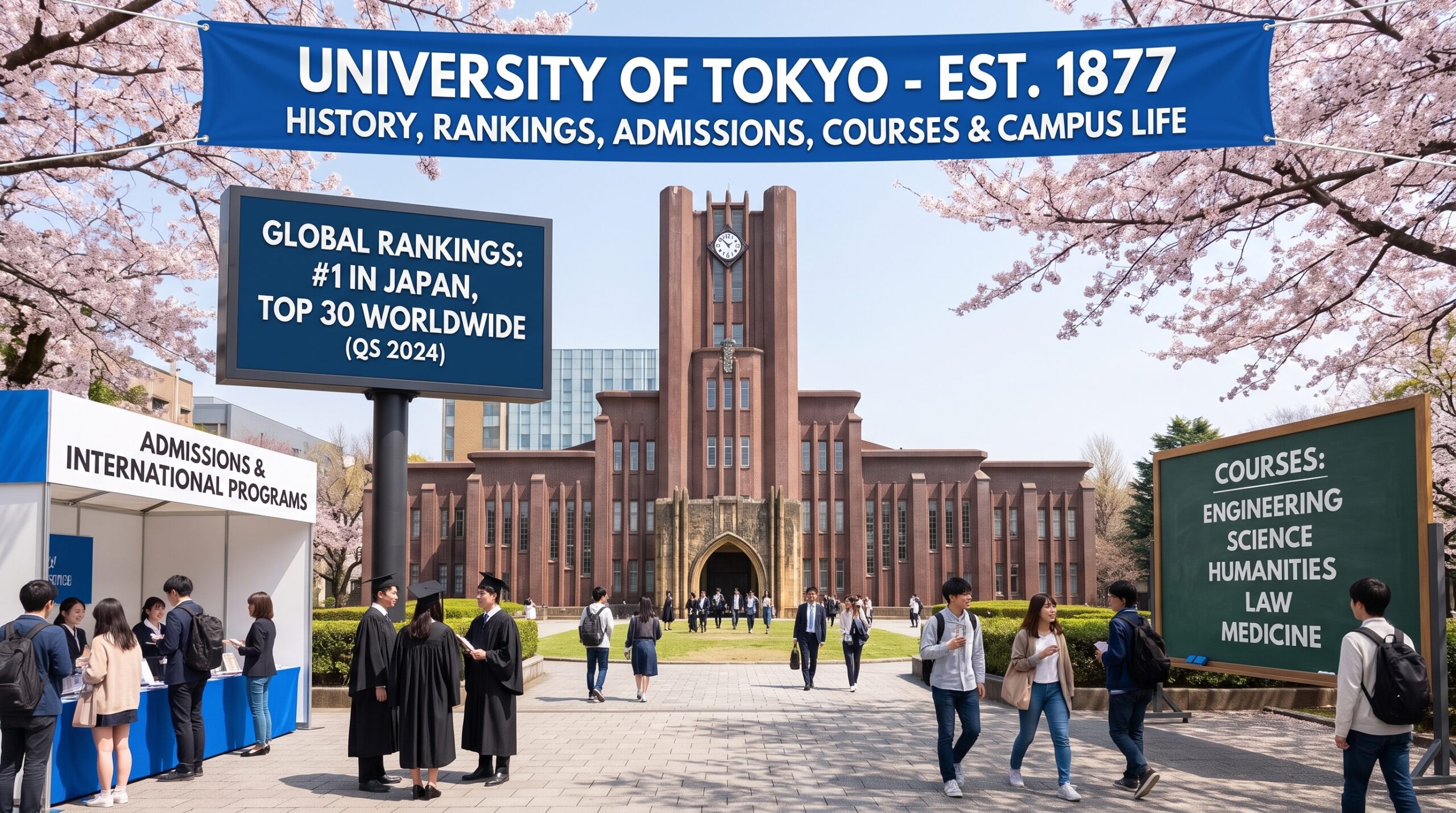
Founded in 1877 during the Meiji Restoration, Todai was the first of Japan’s Imperial Universities. Its mandate was clear: to rapidly absorb Western science, philosophy, and jurisprudence, and synthesize them with Japanese tradition to propel the nation into modernity. The university succeeded unequivocally. Over the past century and a half, the University of Tokyo has produced 16 Japanese Prime Ministers, a legion of Nobel Laureates, and the vast majority of the top-tier bureaucrats who navigate the complex machinery of the Japanese government in Kasumigaseki.
Today, Todai is a massive, globally integrated research behemoth. Spread across three main campuses—the historic, ginkgo-lined Hongo campus in central Tokyo, the youthful Komaba campus, and the futuristic Kashiwa science hub—the university drives world-class innovation in particle physics, robotics, space exploration, and literature. However, despite its deep traditions, Todai is aggressively modernizing, expanding its English-taught programs and drastically increasing its international enrollment to maintain its dominance in a highly competitive global academic landscape. This comprehensive guide details the profound history, brutal selectivity, unique academic structures, and vibrant cultural life of Japan’s premier university.
The Comprehensive History of Todai
Edo Period Roots and Meiji Foundation (1877)
While the University of Tokyo was officially chartered in 1877, its intellectual lineage traces back much further to the Tokugawa shogunate. The institution was formed by the merger of several older government agencies: the *Shoheizaka Gakumonjo* (a center for Confucian study), the *Kaiseijo* (an institute for Western learning and astronomy), and the *Igakusho* (a medical institute). When the Meiji government took power, committed to rapid modernization, they merged the Tokyo Kaisei School and the Tokyo Medical School to form the modern University of Tokyo, establishing the four original faculties of Law, Science, Letters, and Medicine.
In 1886, the institution was renamed the Imperial University (Teikoku Daigaku), later becoming Tokyo Imperial University when other imperial universities (such as Kyoto) were established. During this era, the university was explicitly tasked with serving the state. The Faculty of Law, in particular, was designed as a direct pipeline to staff the national bureaucracy and judiciary, a tradition that persists heavily to this day. The university’s graduates were the architects of Imperial Japan’s legal codes, infrastructure, and rapid industrialization.
World War II and Post-War Democratic Reforms
The devastation of World War II brought profound changes to the university. Following Japan’s surrender in 1945, the Allied occupation authorities dismantled the imperial university system, seeking to democratize higher education and sever its explicit ties to imperial statecraft. In 1947, the institution reverted to its original name, the University of Tokyo.
The post-war era introduced a massive structural change: the creation of the College of Arts and Sciences on the Komaba campus. Influenced by American liberal arts models, the university instituted a mandatory two-year broad education phase for all incoming students before they specialized in their final two years, an anomaly in the highly specialized Japanese system that remains a defining characteristic of a Todai education.
The 1968 Student Protests and the Siege of Yasuda
The late 1960s saw Todai become the epicenter of massive, violent student protests. Mirroring global student movements, radical leftist student factions (the Zenkyoto) occupied campus buildings to protest university administration, tuition costs, and the Vietnam War. The climax of this era was the siege of the iconic Yasuda Auditorium in January 1969. Thousands of riot police were dispatched to clear the barricaded students in a fierce, multi-day battle broadcast on national television. The chaos was so severe that the university was forced to completely cancel its entrance examinations for the 1969 academic year, an unprecedented shock to the Japanese educational system.
Modern Era: Incorporation and Globalization
In 2004, the University of Tokyo, along with all other national universities in Japan, underwent a major administrative reform, being incorporated as a “National University Corporation.” This move granted the university significant financial and administrative autonomy from the Ministry of Education (MEXT), allowing it to pursue aggressive corporate partnerships, independent fundraising, and global expansion.
In the 21st century, under initiatives like the “UTokyo Compass,” the university has aggressively prioritized globalization, diversity, and climate action. It launched high-profile English-taught undergraduate degrees (such as the PEAK program) and forged massive international research alliances to ensure that Todai remains not just the leader of Japan, but a dominant force on the global stage.
Campus Architecture and Landmarks
The University of Tokyo operates across three primary campuses in the Greater Tokyo Area, each with a distinct architectural identity and academic purpose. The transition between these campuses is a defining feature of the Todai student lifecycle.
The Historic Hongo Campus
Located in Bunkyo Ward, central Tokyo, the Hongo campus is the historical and spiritual heart of the university. The land was originally the massive Edo-period estate of the Maeda clan, one of the wealthiest samurai families in feudal Japan. The campus is a stunning blend of surviving Edo architecture, imposing Showa-era gothic brick buildings, and cutting-edge research facilities.
The most famous landmark is the Akamon (Red Gate), built in 1827 to welcome a daughter of the Tokugawa Shogun who married into the Maeda family. Today, it stands as the iconic symbol of the university. The academic center of the campus is the Yasuda Auditorium, a towering, gothic-style clock tower and lecture hall that survived the 1968 student riots and remains the venue for graduation ceremonies.
Hongo is universally famous for its Ginkgo trees. In late autumn, the massive avenues crisscrossing the campus erupt into a brilliant, fiery yellow. The ginkgo leaf is the official symbol of the university, woven into its crest and heavily commercialized on campus merchandise. The campus also houses Sanshiro Pond, a beautiful, secluded traditional Japanese garden popularized by the legendary novelist Natsume Soseki in his novel Sanshiro.
The Komaba Campus
Situated in Meguro Ward, a vibrant and youthful district closer to Shibuya, the Komaba campus is the home of the College of Arts and Sciences. Every single freshman and sophomore at Todai spends their first two years here. Because it houses the underclassmen, the atmosphere at Komaba is vastly different from Hongo—it is louder, more chaotic, and dominated by thousands of student clubs, sports teams, and social “circles.” The architecture is largely functional and modern, with the iconic Clock Tower serving as the central meeting point.
The Kashiwa Campus
Located in Chiba Prefecture, roughly an hour outside central Tokyo, the Kashiwa campus represents the futuristic, research-driven arm of the university. Established in 2000, it is a massive, ultra-modern facility dedicated to the frontier sciences. It houses the Institute for Cosmic Ray Research (which manages the Super-Kamiokande neutrino detector), the Institute for Solid State Physics, and massive supercomputing facilities. It is primarily a graduate and postdoctoral campus, devoid of the undergraduate bustle of Komaba.
Academic Structure: The 10 Faculties
Todai is a massive comprehensive university comprising 10 undergraduate faculties, 15 graduate schools, and 11 affiliated research institutes. The faculties represent the pinnacle of their respective fields in Japan.
- Faculty of Law: Historically the most prestigious faculty, serving as the ultimate pipeline for Japan’s Prime Ministers, supreme court justices, and top-tier civil servants in Kasumigaseki.
- Faculty of Medicine: Universally regarded as the best and most difficult medical school to enter in Japan, deeply connected to the University of Tokyo Hospital.
- Faculty of Engineering: The largest faculty by student population, globally dominant in robotics, civil engineering, and aerospace.
- Faculty of Science: A titan of pure research, producing numerous Nobel Laureates in physics and chemistry.
- Faculty of Letters: The guardian of Japanese literature, philosophy, and history, famously associated with literary giants like Natsume Soseki and Kenzaburo Oe.
- Faculty of Economics: A leading center for macroeconomic theory and corporate management in East Asia.
- Faculty of Agriculture: Pioneering research in sustainable food systems, veterinary medicine, and biotechnology, with extensive farmlands outside Tokyo.
- Faculty of Education: Shapes national educational policy and pedagogy.
- Faculty of Pharmaceutical Sciences: Drives massive innovations in drug discovery and clinical pharmacology.
- College of Arts and Sciences: The unique, interdisciplinary faculty based at Komaba that manages the initial two-year curriculum for all students and offers specialized interdisciplinary senior degrees.
Notable Courses and The “Shingaku Sentaku” System
The Unique 2+2 System
Unlike almost all other Japanese universities where students apply directly to a specific major (e.g., applying to be an engineering student from day one), Todai operates a rigorous 2+2 system. All students are admitted into one of six broad “Streams” (Humanities/Social Sciences I, II, III or Sciences I, II, III). They spend their first two years at the Komaba campus in the College of Arts and Sciences, taking a heavy load of broad liberal arts, foreign languages, and foundational sciences.
The Brutal “Shingaku Sentaku” (Late Specialization)
During their third semester at Komaba, students undergo the Shingaku Sentaku (formerly known as Shingaku Furiwake, or “Shinfuri”). This is a highly stressful, algorithmic process where students compete for their final majors at the Hongo campus based purely on their GPA from their first year and a half.
If a student wants to major in highly coveted departments like Law, Medicine, or specific high-tech engineering tracks, they must maintain near-perfect grades during their liberal arts phase. This system creates an incredibly intense, highly competitive academic environment even *after* students have survived the entrance exams, as slacking off during freshman year can completely derail a student’s intended career path.
PEAK (Programs in English at Komaba) and The Future
In 2012, to combat global isolation, Todai launched PEAK, a highly prestigious, fully English-taught undergraduate degree aimed at elite international students. PEAK offered two tracks: Japan in East Asia (JEA) and Environmental Sciences (ES). The program allowed non-Japanese speakers to earn a Todai degree.
However, the university recently announced a major structural evolution. As of March 2026, the final admissions for the PEAK program were processed. Beginning in September 2027, PEAK will be officially replaced by the “College of Design,” a groundbreaking 5-year combined Bachelor’s and Master’s program taught entirely in English. This massive shift represents Todai’s aggressive strategy to create highly interdisciplinary, globally fluent problem solvers who will graduate with advanced postgraduate credentials, responding to the shifting demands of the global tech and policy landscapes.
Admissions, Selectivity, and Tuition Fees
The General Entrance Examination (Domestic)
For Japanese students, admission to the University of Tokyo is mathematically and psychologically grueling. It is a two-stage process. First, students must take the nationwide Common Test for University Admissions in January. They must score exceptionally high across a vast array of subjects (usually 5 to 7 subjects) just to pass the initial screening.
Those who survive the first cut are invited to Todai’s Second Stage Examination in late February, held on the Hongo campus. This exam is notoriously difficult, focusing entirely on complex, written, long-form essay answers rather than multiple choice. It tests profound critical thinking, advanced mathematics, and deep historical analysis. The overall acceptance rate for domestic applicants generally hovers around 34% to 36%, but this number is deceptive; the applicant pool has already been heavily filtered, consisting almost entirely of the top 1% of high school students in Japan.
International Admissions and PEAK Selectivity
For international students seeking English-taught programs, the admissions process bypasses the Japanese national exams in favor of a Western-style holistic review, heavily utilizing standardized test scores (IB, SAT, A-Levels), essays, and intense academic interviews. For the final PEAK cohorts (2025/2026), the university saw record-breaking application numbers. In the 2026 cycle, 568 students applied for just 55 offers, resulting in a brutal acceptance rate of less than 10%. Interestingly, the demographic of international admits has shifted; while Japanese returnees historically dominated, recent years have seen Chinese, Korean, and American students securing the majority of these highly coveted English-track seats.
Tuition and Financial Affordability
A massive advantage of the University of Tokyo—and Japanese national universities in general—is affordability. Because it is heavily subsidized by the government, the standard annual tuition for undergraduates (both domestic and international) is remarkably low compared to American or British peers. The standard tuition is traditionally set around 535,800 JPY (approx. $3,500 USD) per year, with an initial admission fee of 282,000 JPY.
While there have been recent, highly controversial administrative debates regarding potential hikes to tuition to remain globally competitive in research funding, Todai remains one of the most financially accessible elite universities on the planet. Furthermore, international students are frequently supported by the generous MEXT (Ministry of Education) scholarships, which cover all tuition and provide a monthly living stipend.
University Rankings and Global Reputation
The University of Tokyo is the undisputed #1 university in Japan and operates as a heavy-hitting global research titan, particularly dominant in the hard sciences, space exploration, and engineering.
Institutional Rankings (2025–2026)
| Ranking Publication | Global Rank | Asian Rank | National (Japan) Rank |
|---|---|---|---|
| QS World University Rankings | 36 | Top 10 | 1 |
| Times Higher Education (THE) | 26 | 2 | 1 |
| Academic Ranking of World Universities (ARWU) | 27 | 2 | 1 |
| EduRank Global Top 100 | 19 | 1 | 1 |
Subject-Specific Dominance
According to comprehensive data indices for 2026, Todai holds staggering global subject rankings. It is ranked #1 in the world for Nuclear Physics, and frequently sits in the global top 5 for Chemistry, Condensed Matter Physics, and Optical Engineering. Its research output is astronomical, with over 460,000 academic publications and millions of citations attributed to its faculty and alumni, cementing its status as the scientific engine of Asia.
Campus Life and The Residential Experience
The student experience at Todai is an intense dichotomy between crushing academic pressure and a vibrant, deeply traditional extracurricular culture.
Housing and Commuter Culture
Unlike many Western universities, Japan does not have a massive culture of sprawling, on-campus dormitory villages for all students. A large portion of Todai students commute from family homes in the Greater Tokyo Area via the city’s massive railway network. However, the university does operate several highly sought-after dormitories. For international students and out-of-prefecture domestic students, the Mejirodai International Village and the Komaba Lodge provide excellent, affordable housing. Living in these lodges fosters tight-knit, cosmopolitan communities that serve as a soft landing in the massive metropolis of Tokyo.
Dining at Yasuda
Campus dining is a massive part of Todai culture. The Central Cafeteria (Chuo Shokudo) is famously located entirely underground, directly beneath the Yasuda Auditorium on the Hongo campus. It serves thousands of highly affordable, nutritionally balanced meals daily. A legendary, must-try dish for visitors and students alike is the “Akamon Ramen” (Red Gate Ramen), a spicy, vibrant red noodle dish that pays homage to the campus’s famous landmark.
Student Culture, Extracurriculars, and Traditions
Todai students balance their intense academic burdens with a fierce dedication to extracurricular activities, known as Bukatsu (highly serious sports clubs) and Circles (more relaxed hobby or social groups).
The Twin Festivals: May and Komaba
The academic year is punctuated by two massive campus festivals that draw hundreds of thousands of visitors from across Tokyo. The May Festival (Gogatsusai) is held on the Hongo campus in late May. It is a massive, highly organized event where academic departments showcase their research, and student clubs run hundreds of food stalls across the ginkgo-lined avenues. In late November, the Komaba Festival takes over the junior campus. Organized entirely by freshmen and sophomores, it is slightly more chaotic, youthful, and features incredible stage performances, indie bands, and theatrical shows.
Tokyo Big6 Baseball and the Sokei-Todai Rivalry
Athletics at Todai is defined by its membership in the historic Tokyo Big6 Baseball League, the oldest and most prestigious collegiate sports league in Japan (comprising Todai, Waseda, Keio, Meiji, Hosei, and Rikkyo). Todai is the only public university in the league, and due to its lack of sports scholarships, it famously struggles to win games against its powerhouse private rivals. However, the Todai baseball team is beloved precisely because of this underdog status. When Todai manages to secure a rare victory (such as snapping a 9-year series losing streak), it makes national headlines, and the campus erupts in celebration.
Another major tradition is the fierce rowing rivalry. Todai’s rowing club is highly elite, frequently competing in massive, historic regattas against rivals like Kyoto University and the Waseda-Keio factions on the Sumida River or the Toda Rowing Course.
Notable Alumni and Faculty Legacy
The phrase “Todai graduate” carries a near-mythical weight in Japanese society. The university’s human output has shaped every single facet of modern Japan.
Political Dominance
The University of Tokyo has produced 16 Prime Ministers of Japan, including towering post-war figures like Shigeru Yoshida, Eisaku Sato, Yasuhiro Nakasone, and recent leaders like Fumio Kishida. Furthermore, the vast majority of Japan’s top-tier civil servants (the elite bureaucrats who run the national ministries) are graduates of the Todai Faculty of Law, creating a powerful alumni network known as the Gakubatsu (academic faction) that heavily dictates national policy.
Nobel Laureates and Scientific Titans
As of the 2020s, the University of Tokyo is associated with numerous Nobel Laureates. Masatoshi Koshiba and Takaaki Kajita won Nobel Prizes in Physics for their groundbreaking work on neutrinos utilizing the Kamiokande detectors. Yoichiro Nambu (Physics), Leo Esaki (Physics), and Syukuro Manabe (Physics/Climate) all trace their academic lineage to Todai. In the medical fields, Yoshinori Ohsumi won the Nobel for his discoveries of mechanisms for autophagy.
Literary Masters and Architects
Todai is the bedrock of modern Japanese literature. The legendary Natsume Soseki (author of Kokoro) was both a student and a professor of English literature here. Ryunosuke Akutagawa (author of Rashomon) and Nobel Laureates Yasunari Kawabata and Kenzaburo Oe all graduated from the Faculty of Letters. In architecture, Pritzker Prize winners like Tadao Ando (who served as a professor), Toyo Ito, and Kengo Kuma (who designed the Tokyo 2020 Olympic Stadium and serves as a Todai professor) highlight the university’s profound aesthetic influence.
Todai and the Metropolis of Tokyo
The relationship between the university and the city of Tokyo is deeply symbiotic. Tokyo is the largest metropolitan economy in the world, and Todai utilizes the city as an expansive laboratory. Students in urban engineering actively consult on Tokyo’s massive railway and infrastructure projects. Business students secure elite internships in the financial districts of Marunouchi and Otemachi. Because the campuses are centrally located, students have instant access to the unparalleled cultural, culinary, and technological resources of Shibuya, Akihabara, and Shinjuku, blending rigorous academic isolation with hyper-urban integration.
Records & Achievements
- Political Engine: Educated 16 Japanese Prime Ministers and the vast majority of the nation’s elite civil service bureaucracy.
- Nobel Pedigree: Associated with numerous Nobel Laureates, heavily dominating the categories of Physics, Chemistry, and Literature in Asia.
- Neutrino Research: Operates the Institute for Cosmic Ray Research, managing the Super-Kamiokande detector that has revolutionized global particle physics.
- Global Subject Dominance: Consistently ranked #1 globally in specific disciplines such as Nuclear Physics and #1 overall in Japan across all major ranking indices.
- Architectural Heritage: The Akamon (Red Gate) is a registered Important Cultural Property of Japan, standing since 1827.
Frequently Asked Questions (FAQ)