Introduction
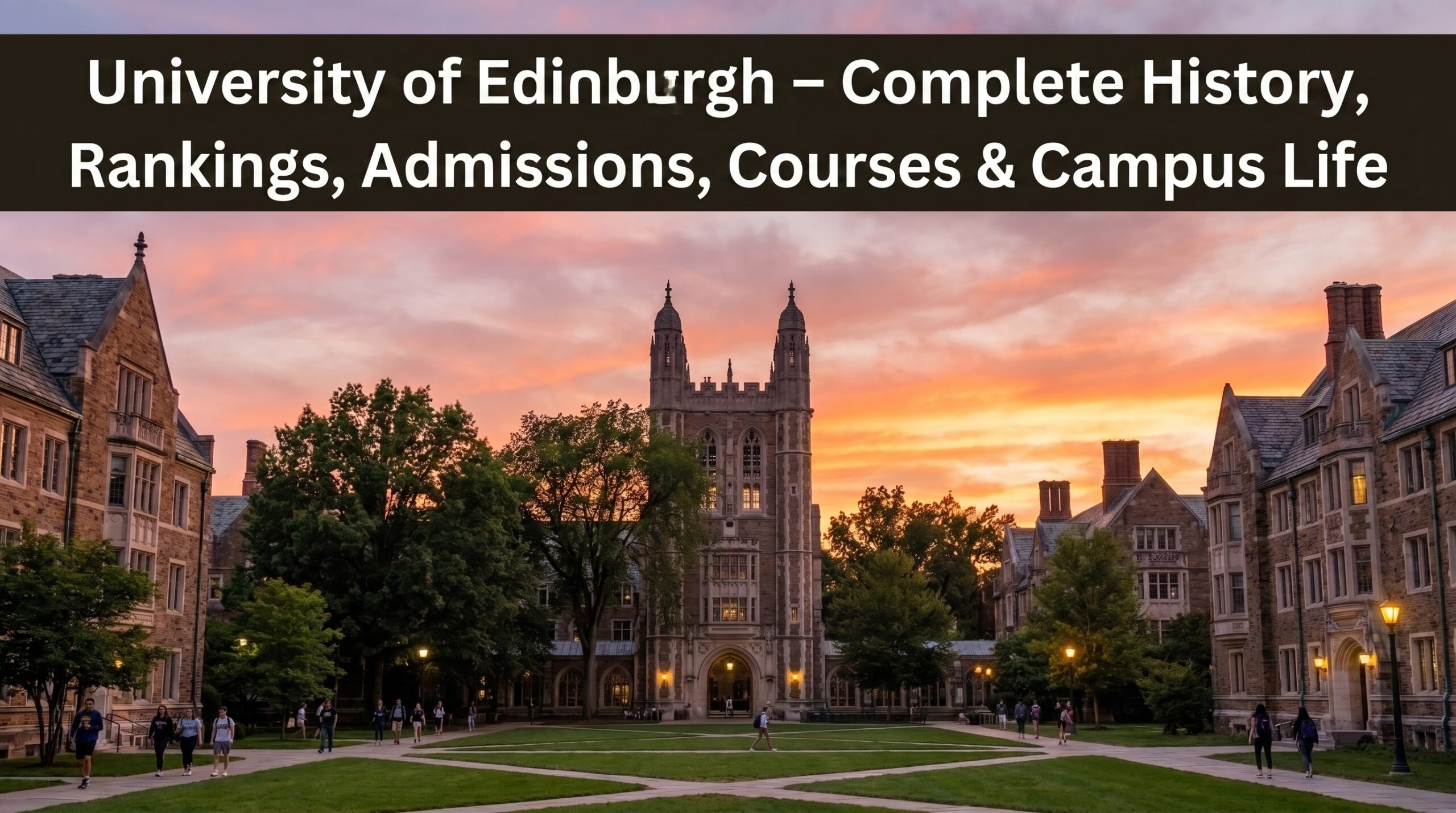
The University of Edinburgh operates as a deeply integrated component of the city itself. Often referred to as the “Athens of the North,” the city of Edinburgh provides a dramatic, gothic, and culturally vibrant backdrop to the university’s cutting-edge research facilities. The institution perfectly bridges the gap between historical reverence and aggressive modern innovation. While it proudly maintains the centuries-old architectural splendor of the Old College and the theological gravitas of New College on the Mound, it simultaneously houses the Informatics Forum—one of Europe’s premier hubs for artificial intelligence and supercomputing—and the Roslin Institute, globally famous for the cloning of Dolly the sheep.
Today, the University of Edinburgh is a massive, cosmopolitan academic juggernaut. It is a leading member of the Russell Group of research-intensive UK universities and a founding member of the League of European Research Universities. It attracts over 40,000 students from more than 150 countries, resulting in one of the most diverse and vibrant student bodies in the world. This comprehensive profile explores the university’s profound historical trajectory, the unique intricacies of the Scottish degree system, the brutal selectivity of its admissions process, and the fiercely independent, deeply cultural student life that thrives within the shadow of Edinburgh Castle.
The Comprehensive History of the University
The Tounis College and Founding (1582)
The genesis of the University of Edinburgh is unique among the ancient universities of Scotland. While St Andrews, Glasgow, and Aberdeen were founded by papal bulls (edicts from the Pope), Edinburgh was founded following the Scottish Reformation. It was established by a Royal Charter granted by King James VI in 1582, but crucially, the driving force behind its creation was the Town Council of Edinburgh. Because it was funded and governed by the local municipality rather than the church, it was originally known as the “Tounis College” (Town’s College). This civic foundation gave the university a notably more secular and practical orientation than its ecclesiastical predecessors.
The college officially opened its doors in 1583 under the leadership of Robert Rollock, its first Regent. Initially, the curriculum was heavily structured around the traditional medieval quadrivium and trivium, focusing on theology, logic, and classical languages to train clergymen for the newly established Presbyterian Church of Scotland. However, situated in the political and mercantile capital of Scotland, the institution rapidly expanded its intellectual horizons. By the late 17th century, it was pioneering the teaching of modern subjects, adopting the groundbreaking scientific theories of Isaac Newton well before many older European institutions.
The Scottish Enlightenment (18th Century)
The 18th century represented the absolute zenith of the University of Edinburgh’s cultural and historical influence. During this period, the university became the beating heart of the Scottish Enlightenment, an intellectual movement that fundamentally altered Western philosophy, sociology, and economics. The university championed empiricism, rational inquiry, and humanism. It transformed Edinburgh into the “Athens of the North,” a city teeming with intellectual salons, debating societies, and prolific publishing houses.
The roster of minds associated with the university during this era is staggering. David Hume, widely considered the greatest philosopher to write in the English language, applied his radical skepticism while engaging with the university’s intellectual elite. Principal William Robertson became a towering figure in European historiography, and Joseph Black revolutionized chemistry by discovering latent heat and carbon dioxide. The atmosphere of intellectual ferocity fostered by the university during the Enlightenment established pedagogical principles—particularly the emphasis on broad, critical thought—that continue to define the Scottish educational system today.
Medical Dominance and The Edinburgh Seven (19th Century)
As the 19th century dawned, the University of Edinburgh shifted its primary dominance from philosophy to medicine and the natural sciences. The Edinburgh Medical School became universally regarded as the premier medical institution in the English-speaking world. It attracted students from across the British Empire and the United States, deeply influencing the founding of medical schools in North America (including the University of Pennsylvania and McGill University).
This era produced extraordinary scientific figures. Charles Darwin studied medicine at Edinburgh before abandoning it for natural history, finding the surgical theaters too gruesome. Arthur Conan Doyle studied under Dr. Joseph Bell, an Edinburgh professor whose astonishing deductive diagnostic skills served as the direct inspiration for the character of Sherlock Holmes. James Clerk Maxwell, whose equations unified electricity and magnetism, laid the groundwork for modern physics while studying at the university.
The 19th century also witnessed a monumental battle for gender equality. In 1869, a group of trailblazing women, known as the “Edinburgh Seven,” led by Sophia Jex-Blake, fought a bitter legal and social battle to become the first undergraduate female matriculants in a British university. Although the university ultimately thwarted their attempt to graduate with medical degrees through legal loopholes, their campaign sparked national outrage, directly leading to the UK Universities (Scotland) Act of 1889, which finally allowed women to graduate from Scottish universities.
20th Century Expansion and Modern Era
Throughout the 20th and 21st centuries, the University of Edinburgh transformed from a highly elite, localized institution into a massive, globally integrated research powerhouse. Following World War I, the university significantly expanded its physical footprint, constructing the King’s Buildings campus to house its rapidly growing science and engineering faculties. In 1998, the university merged with the Moray House Institute of Education, and in 2011, it merged with the Edinburgh College of Art, massively diversifying its academic portfolio.
In the modern era, Edinburgh has cemented its status as a pioneer in computer science, artificial intelligence, and genetics. It was at the university’s Roslin Institute that scientists successfully cloned Dolly the sheep in 1996, the first mammal cloned from an adult somatic cell. Furthermore, Professor Peter Higgs, a theoretical physicist at the university, proposed the existence of the Higgs boson particle in 1964—a discovery confirmed by CERN nearly fifty years later, earning him the Nobel Prize in Physics. Today, the university continues to drive massive global research initiatives, leveraging its immense endowment and deep international partnerships.
Campus Architecture and Distinct Regions
The University of Edinburgh does not possess a traditional, enclosed campus. Instead, its buildings are deeply interwoven into the urban fabric of the city, spanning several distinct geographic nodes, each characterized by radically different architectural styles and academic disciplines.
The Central Area (George Square and Old College)
The Central Area, located primarily in the city’s historic Southside, serves as the academic heart for the humanities, social sciences, law, and administration. The crown jewel of this area is the Old College. Designed by the legendary architects Robert Adam and William Henry Playfair in the late 18th century, Old College is a breathtaking neoclassical quadrangle. Its grand dome, topped by a golden statue of “Youth” holding the torch of knowledge, houses the prestigious School of Law and the Playfair Library Hall, a magnificent vaulted room lined with classical pillars.
A short walk away lies George Square, the mid-century modern hub of the campus. Here, students flock to the massive Main Library, one of the largest academic libraries in Europe. Nearby stands McEwan Hall, a spectacular, D-shaped Renaissance-style building completed in 1897. Its interior features stunning murals, an immense pipe organ, and a massive domed ceiling. McEwan Hall is the emotional apex of the student journey, serving as the venue for all graduation ceremonies.
New College and The Mound
Dominating the Edinburgh skyline and situated directly next to Edinburgh Castle on the Mound, New College houses the School of Divinity. Constructed in the 1840s in a dramatic, dark Gothic Revival style, its towering twin spires and imposing courtyard look as though they were conjured from a dark fantasy novel. New College boasts the massive Assembly Hall, which famously hosted the Scottish Parliament prior to the construction of their modern building at Holyrood.
The King’s Buildings
Located about two miles south of the city center, the King’s Buildings (KB) campus is the massive, sprawling home of the College of Science and Engineering. Established in the 1920s to relieve overcrowding in the Central Area, KB is a vast complex of laboratories, lecture theaters, and research institutes. The architecture here ranges from traditional 1920s red brick to ultra-modern, eco-friendly glass structures like the James Clerk Maxwell Building and the futuristic Noreen and Kenneth Murray Library.
BioQuarter and Easter Bush
Representing the university’s dominance in medicine and veterinary sciences, these two specialized campuses sit on the outskirts of the city. The Edinburgh BioQuarter (located in Little France) is a colossal biomedical research park integrating the University’s Medical School with the Royal Infirmary of Edinburgh, focusing heavily on translational medicine and stem cell research. Further south lies the Easter Bush Campus, the renowned home of the Royal (Dick) School of Veterinary Studies and the Roslin Institute, a global powerhouse for animal sciences and genetics.
Academic Structure and The Three Colleges
Unlike many universities that divide into dozens of small, autonomous faculties, the University of Edinburgh underwent a massive academic restructuring in 2002. It consolidated its dozens of faculties into three massive, overarching “Colleges,” which collectively house 21 specific academic Schools.
College of Arts, Humanities and Social Sciences (CAHSS)
CAHSS is the largest and most historically prominent of the three colleges. It spans 12 distinct Schools, encompassing everything from History, Classics, and Archaeology to Literature, Languages, and Cultures. CAHSS is globally renowned for its School of Philosophy, Psychology and Language Sciences, continuing the unbroken legacy of the Scottish Enlightenment. The Edinburgh College of Art (ECA), which merged into CAHSS in 2011, offers world-class training in fine art, architecture, and design. Furthermore, the University of Edinburgh Business School and the Edinburgh Law School (which operates entirely on a distinct Scots Law system, heavily influenced by Roman civil law) fall under this massive umbrella.
College of Medicine and Veterinary Medicine (CMVM)
Operating as a unified behemoth of health sciences, CMVM is unique in the UK for combining human and animal medicine into a single administrative college. The Edinburgh Medical School is one of the most prestigious in Europe, offering an extraordinarily rigorous, research-intensive MBChB degree. The Royal (Dick) School of Veterinary Studies, colloquially known as “The Dick Vet,” is routinely ranked among the top veterinary schools globally, operating massive animal hospitals and equine centers at the Easter Bush campus.
College of Science and Engineering (CSE)
Based primarily at the King’s Buildings, CSE is a global titan of STEM research. It comprises seven Schools, including Biological Sciences, Chemistry, Engineering, Geosciences, Mathematics, and Physics & Astronomy. However, the absolute crown jewel of this college is the School of Informatics. It is the largest informatics research center in Europe, consistently ranked among the world’s absolute best for artificial intelligence, machine learning, and cognitive science. The School operates out of the stunning, award-winning Informatics Forum in the Central Area, driving massive innovation in global computing.
Notable Courses and The Scottish Degree System
The Four-Year Degree and The Master of Arts (MA Hons)
To understand the academic pedagogy of the University of Edinburgh, one must understand the unique nature of the Scottish university system. Unlike universities in England, Wales, or Northern Ireland where an undergraduate degree typically takes three years, the standard undergraduate degree in Scotland takes four years (mirroring the system adopted by the United States).
Furthermore, in a tradition unique to the ancient universities of Scotland (Edinburgh, St Andrews, Glasgow, and Aberdeen), students studying in the humanities, arts, or social sciences do not graduate with a Bachelor of Arts (BA). Instead, they graduate with an undergraduate Master of Arts, MA (Hons). This degree title is a historical quirk and does not indicate postgraduate study, though it carries immense historical prestige.
Unmatched Academic Flexibility
The defining feature of the Scottish four-year system is profound academic flexibility. During their first two years (pre-honours), students are usually required to study three distinct subjects. For example, a student admitted to study History might also take modules in Philosophy and Economics. This system encourages intellectual exploration and cross-disciplinary thought. At the end of their second year, students finalize their major subject (or joint honors subjects) and proceed into their highly specialized third and fourth years (honours years), culminating in a massive independent research dissertation.
Admissions, Selectivity, and Financial Fees
The UCAS Process and Selectivity
Admission to the University of Edinburgh is brutally competitive, reflecting its status as a global academic powerhouse. All undergraduate applications are processed through the UK’s centralized Universities and Colleges Admissions Service (UCAS). Edinburgh frequently receives over 75,000 to 80,000 applications annually for approximately 6,000 to 7,000 undergraduate spots, making it one of the most popular and highly applied-to universities in the United Kingdom.
The overall acceptance rate typically hovers around 10% to 12% for the most highly competitive programs (such as Medicine, Informatics, Law, and International Relations). The university demands exceptional academic credentials; standard conditional offers for UK students often require A-level grades of A*AA to AAA, or Scottish Advanced Highers of AAA to AAB. For international students utilizing the IB system, offers frequently demand 38 to 42 points overall. The admissions committee heavily scrutinizes the UCAS personal statement, seeking profound intellectual curiosity and a clear, demonstrated passion for the chosen subject.
The Complex Fee Status System
The financial reality of attending the University of Edinburgh is heavily dictated by the applicant’s residency status, a system uniquely complicated by Scottish devolution and post-Brexit regulations.
- Scottish Domiciled Students: Due to policies established by the Scottish Government, undergraduate tuition for students permanently residing in Scotland is completely free, funded by the Student Awards Agency Scotland (SAAS). Because these spots are heavily capped by government funding quotas, admission for Scottish students is statistically the most fiercely competitive category.
- Rest of UK (rUK) Students: Students from England, Wales, and Northern Ireland are charged a fixed tuition fee, currently capped at £9,250 per year. These students are eligible for standard UK student loans to cover this cost.
- International Students: Students from outside the UK face exorbitant, unregulated tuition fees. For degrees in the arts and humanities, international fees typically range from £24,000 to £28,000 per year. For lab-based science degrees, fees easily exceed £34,000 per year. The MBChB Medicine degree for international students is extraordinarily expensive, often exceeding £50,000 per year.
Contextual Admissions
Edinburgh places a massive emphasis on widening participation and social mobility. The university operates a highly aggressive contextual admissions policy. If a student resides in a heavily deprived postcode (identified by the SIMD or IMD indices), attends a low-performing state school, or has spent time in the care system, they are frequently offered admission at a significantly lower grade threshold to ensure equitable access to elite higher education.
University Rankings and Global Reputation
The University of Edinburgh is universally acknowledged as a top-tier global research institution. Backed by its prestigious Russell Group status and a massive research endowment, it maintains an iron grip on the upper echelons of both domestic and international rankings.
Institutional Rankings (2025–2026)
| Ranking Publication | Global Rank | National (UK) Rank |
|---|---|---|
| QS World University Rankings | 22 | 5 |
| Times Higher Education (THE) | 30 | 6 |
| Academic Ranking of World Universities (ARWU) | 38 | 6 |
| U.S. News & World Report Global | 34 | 5 |
| The Complete University Guide (Domestic) | – | 11 |
Subject-Specific Dominance
Beyond broad institutional scores, Edinburgh dominates globally across highly specific disciplines. The School of Informatics is a permanent fixture in the top 15 globally for computer science and artificial intelligence. Linguistics and English Literature are universally lauded, frequently ranking within the top 10 worldwide. Furthermore, Edinburgh holds unparalleled global supremacy in Veterinary Medicine, consistently ranking in the top 5 globally due to the colossal research output of the Roslin Institute.
Campus Life and Accommodation
The student experience at the University of Edinburgh is defined by intense academic independence combined with the boundless cultural opportunities of living in a major European capital.
Accommodation: Pollock Halls and City Living
The university guarantees accommodation for all first-year undergraduate students who live outside the city. The most famous residential complex is Pollock Halls of Residence, located at the foot of the magnificent Holyrood Park and Arthur’s Seat. Pollock Halls operates primarily on a catered basis, where students eat communal meals in the massive John McIntyre Conference Centre. Living in Pollock—particularly in traditional houses like Chancellor’s Court or Holland House—provides a highly structured, heavily social introduction to university life.
However, many students opt for the dozens of self-catered university flats scattered throughout the city center and the vibrant Cowgate area. After their first year, the vast majority of students move into private rented flats in popular, highly student-dense neighborhoods like Marchmont, Bruntsfield, and Newington, seamlessly integrating into the broader civic life of Edinburgh.
The Edinburgh City Experience
The city of Edinburgh, affectionately known as “Auld Reekie,” is effectively the campus. Students walk to lectures past 12th-century castles, study in cafes tucked down ancient closes, and climb Arthur’s Seat—a dormant volcano sitting squarely in the city center—to relieve academic stress. The city is highly walkable, exceptionally safe, and boasts an unparalleled pub culture and literary heritage, serving as a UNESCO City of Literature.
Student Culture, Societies, and Traditions
The extracurricular ecosystem at Edinburgh is ferociously active, characterized by a student body that is highly international, fiercely artistic, and relentlessly ambitious.
EUSA and Teviot Row House
The Edinburgh University Students’ Association (EUSA) manages the vast social architecture of the university. The crown jewel of EUSA is Teviot Row House. Opened in 1889 in the heart of Bristo Square, Teviot is the oldest purpose-built student union building in the world. Designed in a stunning Gothic style, its labyrinthine interior features six different bars (including the famous Library Bar), a nightclub, and countless society meeting rooms. It serves as the undisputed social epicenter for the student body.
Societies and The Student Media
EUSA supports over 290 student-led societies, catering to every conceivable niche. The media ecosystem is incredibly robust. The Student, founded in 1887 by Robert Louis Stevenson, is the oldest student newspaper in the United Kingdom. Operating completely independently, it has served as the training ground for generations of prominent British journalists and politicians.
The Edinburgh Festival Fringe
The cultural rhythm of the university is uniquely tied to the Edinburgh Festival Fringe, the largest arts festival in the world. Every August, the city’s population doubles as performers, comedians, and artists from across the globe descend on Edinburgh. The university plays a massive role in this; virtually all university buildings, including Teviot Row House, the Pleasance, and George Square, are transformed into massive Fringe venues. Many students remain in the city over the summer to work at the festival, perform in theatrical troupes, or manage venues, providing unparalleled experience in the global arts industry.
Sports and BUCS Competitions
The university fields dozens of highly competitive sports teams, operating under the banner of Edinburgh University Sports Union (EUSU). The primary athletic facility is the massive Pleasance Sports Complex and the Peffermill Playing Fields. The university consistently ranks within the top 5 in the British Universities and Colleges Sport (BUCS) rankings, with particular national dominance in rowing, rugby, and field hockey.
Notable Alumni and Faculty Legacy
The human output of the University of Edinburgh has fundamentally shaped global science, philosophy, literature, and political governance. The university’s alumni network is staggeringly influential, boasting 19 Nobel Laureates, three UK Prime Ministers, and numerous international heads of state.
Scientific Pioneers and Nobel Laureates
Edinburgh’s scientific legacy is monumental. Charles Darwin, the father of evolutionary biology, began his university career studying medicine at Edinburgh. James Clerk Maxwell, who formulated the classical theory of electromagnetic radiation, and Alexander Graham Bell, the inventor of the telephone, both studied at the university. In modern physics, Peter Higgs formulated the Higgs mechanism while serving as a professor at Edinburgh, ultimately winning the Nobel Prize. In the medical field, Joseph Lister pioneered antiseptic surgery during his tenure at the Royal Infirmary, saving countless lives.
Literary Giants and Creative Minds
The university has nurtured legendary literary movements. Sir Arthur Conan Doyle, creator of Sherlock Holmes, earned his medical degree here. Historical novelist Sir Walter Scott and Treasure Island author Robert Louis Stevenson are prominent alumni. In modern literature, Ian Rankin, the famous crime novelist, is an alumnus who frequently sets his novels in the city. (While J.K. Rowling famously wrote Harry Potter in Edinburgh cafes and holds an honorary degree, she is not an academic alumna, though the university’s gothic architecture is widely acknowledged as a massive inspiration for her work).
Political Leaders and Thinkers
In philosophy and economics, the university claims David Hume and claims heavy association with Adam Smith, who delivered highly influential lectures in the city. In the realm of politics, the university has educated three UK Prime Ministers, including Gordon Brown and Lord Palmerston. Internationally, the university educated Julius Nyerere, the first President of Tanzania, and numerous signatories of the United States Declaration of Independence, including John Witherspoon.
Records & Achievements
- Dolly the Sheep: In 1996, scientists at the university’s Roslin Institute successfully cloned Dolly the sheep, the first mammal cloned from an adult somatic cell, revolutionizing genetic research.
- The Higgs Boson: Professor Peter Higgs predicted the existence of the Higgs boson particle in 1964, a cornerstone of modern particle physics, leading to his 2013 Nobel Prize.
- Oldest Student Union: Teviot Row House, opened in 1889, is the oldest purpose-built student union building in the world.
- Oldest Student Newspaper: The Student, founded by Robert Louis Stevenson in 1887, is the oldest student newspaper in the UK.
- The Edinburgh Seven: The university was the site of the historic 1869 campaign by the Edinburgh Seven, the first women to ever matriculate at a British university.
Frequently Asked Questions (FAQ)