Introduction
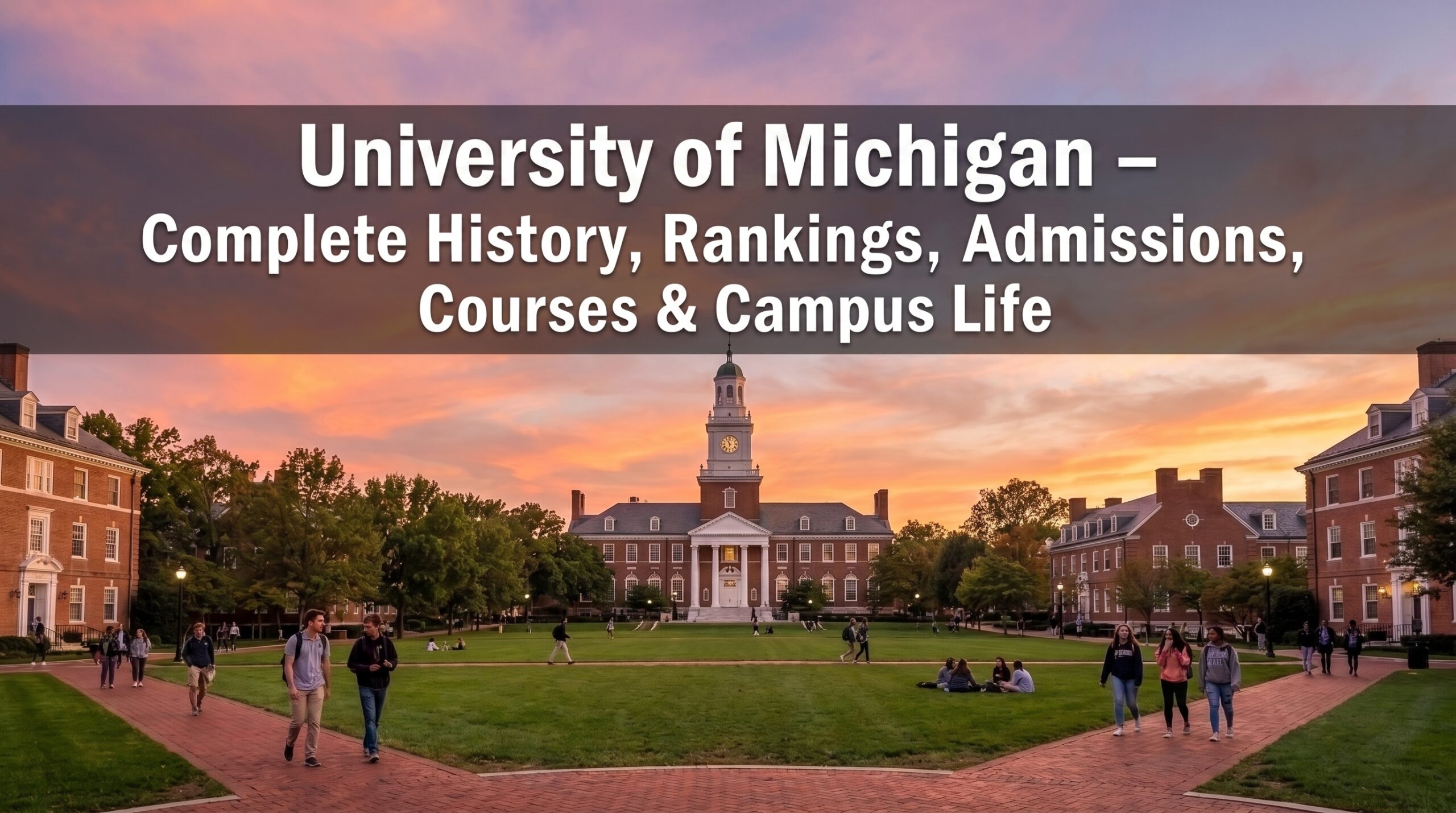
Founded twenty years before the territory of Michigan even achieved statehood, the university’s history is deeply intertwined with the development of the American Midwest. From its quirky origins in Detroit to its expansive, multi-campus footprint in Ann Arbor, U-M has served as a crucible for monumental events in American history. It is the place where President John F. Kennedy first proposed the Peace Corps, where the polio vaccine was proven safe and effective, and where student activists ignited national movements during the 1960s civil rights and anti-war eras.
Today, the University of Michigan operates as an academic juggernaut. It consistently leads the nation in public university research volume, funneling billions of dollars into groundbreaking medical, engineering, and social science initiatives. The phrase “The Michigan Difference” is not merely a marketing slogan; it represents a deeply ingrained cultural ethos among its students and alumni—a belief that U-M graduates are uniquely equipped to become the “Leaders and Best” in any field they pursue. This comprehensive guide details the profound history, grueling admissions standards, vibrant campus culture, and enduring global legacy of the University of Michigan.
The Comprehensive History of the University of Michigan
Origins: The Catholepistemiad of Michigania (1817)
The origins of the University of Michigan are deeply rooted in the enlightenment ideals of the early 19th century. In 1817, the governor and judges of the Michigan Territory passed an act establishing the “Catholepistemiad, or University of Michigania” in Detroit. This uniquely named institution was the brainchild of Augustus B. Woodward, a territorial judge and close friend of Thomas Jefferson. The original vision was grandiose, intending to create a centralized, state-supported system of education spanning from primary schools to the university level, heavily influenced by the French educational system.
The institution began humbly in a single building on Bates Street in Detroit. Its first president was Reverend John Monteith, a Presbyterian minister, while Father Gabriel Richard, a Catholic priest, served as vice president. This cross-denominational partnership at the helm of a public institution was highly unusual for the era and set an early precedent for the university’s commitment to secular, broad-based education. However, the Detroit location proved restrictive as the territory grew.
The Move to Ann Arbor and the Angell Era (1837–1909)
In 1837, the year Michigan officially became a state, the legislature voted to relocate the university to Ann Arbor, a burgeoning town situated on the Huron River. The new campus consisted of an original 40-acre plot—what is now known as the “Diag”—generously donated by local land speculators to secure the institution’s presence. In its first year in Ann Arbor, the university boasted just two professors and seven students.
The true transformation of the University of Michigan into an academic powerhouse occurred under the legendary presidency of James Burrill Angell, who served from 1871 to 1909. Angell aggressively expanded the curriculum, incorporating modern languages, history, and the sciences, moving away from the strict classical recitation models of the past. He heavily promoted the idea that a public university should serve the state while competing with the elite private colleges of the East Coast, famously declaring his vision to provide “an uncommon education for the common man.” Under his leadership, U-M became known as the “Athens of the West,” attracting brilliant scholars and establishing prestigious professional schools in law, medicine, and engineering.
Activism, the Peace Corps, and the 1960s
The mid-20th century cemented the University of Michigan’s reputation as a bastion of progressive thought and student activism. On October 14, 1960, at 2:00 a.m., presidential candidate John F. Kennedy delivered an impromptu, historic speech on the steps of the Michigan Union to an estimated 10,000 students. He challenged the students to dedicate part of their lives to serving developing nations, a moment that directly inspired the creation of the United States Peace Corps.
Throughout the 1960s, Ann Arbor was a major epicenter of the American counterculture and civil rights movements. The campus served as the birthplace of the Students for a Democratic Society (SDS), and the highly influential “Port Huron Statement” was drafted largely by U-M students. In 1965, faculty and students pioneered the “teach-in” model as a form of protest against the Vietnam War. In 1970, the Black Action Movement (BAM) launched a massive, highly coordinated campus strike that effectively shut down the university, resulting in commitments from the administration to significantly increase minority enrollment and establish a Center for Afroamerican and African Studies.
Modern Era: Research Dominance and the Biosciences Initiative
In the late 20th and 21st centuries, U-M has focused on aggressive interdisciplinary research and physical expansion. The university played a pivotal role in the creation of the modern internet; in the 1980s, U-M partnered with IBM and MCI to build NSFNET, the direct precursor to the commercial internet. In recent decades, under presidents like Mary Sue Coleman and Santa J. Ono, the university has invested heavily in the Biosciences Initiative, the Mcubed research funding program, and the autonomous vehicle testing facility known as “Mcity,” ensuring its position at the absolute frontier of modern scientific inquiry.
Campus Architecture and Distinct Regions
The University of Michigan does not possess a single, continuous campus. Instead, the university operates across four distinct geographic regions in Ann Arbor, each featuring its own unique architectural identity, academic focus, and student culture. The campus is so massive that the university operates an extensive, highly efficient free bus system—the iconic Blue Buses—to transport students between these hubs.
Central Campus and The Diag
Central Campus is the historical and geographical heart of the university. It seamlessly blends with downtown Ann Arbor, creating a quintessential “town and gown” atmosphere. The architectural centerpiece is the Diag, a massive diagonal grassy quadrangle crisscrossed by concrete paths. It is the premier social gathering space, hosting student rallies, club recruitment, and impromptu performances.
Surrounding the Diag are stunning examples of collegiate architecture. Angell Hall, with its massive Doric columns, serves as the majestic entrance to the College of Literature, Science, and the Arts (LSA). The Hatcher Graduate Library offers commanding views of the campus, while the Burton Memorial Tower—housing a massive carillon—chimes daily across the quad. A famous campus superstition involves the brass block “M” embedded in the center of the Diag: students believe that stepping on the “M” before taking their first blue book exam will result in a failing grade, leading to the amusing sight of thousands of students subconsciously detouring around it.
The Law Quadrangle
Located on the southern edge of Central Campus, the William W. Cook Law Quadrangle is widely considered one of the most beautiful architectural spaces in American higher education. Constructed entirely in the English Gothic style, it features towering stone spires, intricate gargoyles, and leaded glass windows. The Legal Research Building, with its massive, cathedral-like Reading Room, looks as though it was lifted directly from Oxford or Cambridge. It provides an isolated, intensely quiet sanctuary for law students and awestruck undergraduates alike.
North Campus
Located across the Huron River, North Campus represents the future-focused, technological arm of the university. Established in the 1950s, the architecture here is decidedly mid-century modern and brutalist, featuring extensive use of brick, concrete, and glass. North Campus is home to the College of Engineering, the School of Music, Theatre & Dance, the Taubman College of Architecture and Urban Planning, and the Stamps School of Art & Design.
The atmosphere on North Campus is notably quieter, more suburban, and intensely focused. Its defining landmark is the Lurie Bell Tower, a modern structural contrast to Burton Tower on Central. North Campus also houses Mcity, a massive, simulated urban environment designed explicitly for testing autonomous and connected vehicles.
South Campus (The Athletic Campus)
South Campus is dedicated almost entirely to athletics and recreational facilities. It is dominated by the colossal Michigan Stadium, affectionately known as “The Big House.” With an official capacity of 107,601, it is the largest stadium in the Western Hemisphere and the third largest in the world. South Campus also houses the Crisler Center (basketball), Yost Ice Arena (hockey), and expansive training facilities, serving as the roaring, maize-and-blue epicenter of U-M school spirit.
Academic Structure and Major Schools
The University of Michigan operates 19 distinct colleges and schools, offering over 280 degree programs. The academic ecosystem is characterized by an immense breadth of offerings, allowing students to pursue highly specialized, world-class education in virtually any discipline imaginable.
College of Literature, Science, and the Arts (LSA)
LSA is the massive, intellectual cornerstone of the university. Enrolling over 17,000 undergraduate students, it is by far the largest college at U-M. LSA offers a profound liberal arts education embedded within a massive research institution. Its departments in Political Science, History, Sociology, and Psychology are consistently ranked among the top 10 nationwide. LSA students have access to unparalleled resources, including the specialized Honors Program, which offers smaller seminars and intensive faculty mentorship.
College of Engineering (CoE)
Located on North Campus, the College of Engineering is a global titan of applied sciences. Routinely ranked in the top 10 engineering programs in the United States, CoE is massive in both scale and funding. It excels particularly in Aerospace, Mechanical, Industrial, and Nuclear Engineering. CoE heavily emphasizes hands-on, multidisciplinary design, requiring students to collaborate on complex projects ranging from solar-powered vehicles to small satellites (CubeSats) launched in partnership with NASA.
Stephen M. Ross School of Business
The Ross School of Business is arguably one of the most prestigious and highly competitive undergraduate and graduate business schools in the world. Housed in a stunning, state-of-the-art facility on Central Campus, Ross is famous for its “action-based learning” curriculum. Students do not just study business cases; they consult for real multinational corporations, manage real investment funds (such as the massive student-run Wolverine Venture Fund), and launch scalable startups. Admission to the undergraduate BBA program is notoriously brutal, requiring exceptional academic credentials and demonstrated leadership.
University of Michigan Medical School and Michigan Medicine
The U-M Medical School, operating in tandem with the massive Michigan Medicine hospital complex, is a premier institution for clinical care and biomedical research. The medical campus literally borders Central Campus, fostering deep interdisciplinary collaboration. The school famously conducted the clinical trials that proved Jonas Salk’s polio vaccine was safe and effective. Today, it leads the world in research areas such as cardiovascular disease, organ transplantation, and the development of extracorporeal membrane oxygenation (ECMO) technology.
Law School & Ford School of Public Policy
The Michigan Law School is a permanent fixture in the top 15 law schools nationwide (the “T14”). It operates out of the magnificent Law Quad and is renowned for its programs in international law, clinical training, and its highly collaborative student culture, eschewing the cutthroat competitiveness seen at peer institutions. The Gerald R. Ford School of Public Policy is a highly selective boutique program offering elite training in domestic policy, international diplomacy, and applied economics, frequently bringing heads of state and global policymakers to campus.
School of Information (UMSI)
A rapidly growing and highly innovative college, UMSI operates at the intersection of people, information, and technology. It offers incredibly popular undergraduate and graduate degrees in data science, UX/UI design, and information analysis. As the tech industry has expanded, UMSI has become a massive feeder school for companies like Google, Apple, and Amazon.
Notable Courses and Signature Academic Programs
Undergraduate Research Opportunity Program (UROP)
Because U-M conducts over $1.8 billion in research annually, it places a massive emphasis on involving undergraduates in this process. UROP is a flagship program that pairs first- and second-year students directly with faculty members to conduct real, high-impact research. Whether analyzing historical archives in the library, sequencing genomes in the medical school, or building robotics on North Campus, UROP ensures that undergraduates are actively generating new knowledge rather than just sitting in massive lecture halls.
Michigan Learning Communities (MLCs)
To make the massive university feel smaller and more intimate, U-M offers heavily utilized Michigan Learning Communities. These are specialized residential programs where students with shared academic interests live together in specific dormitories and take specialized courses. Examples include the Residential College (RC), which focuses heavily on intensive foreign language immersion and the humanities; the Michigan Research and Discovery Scholars (MRADS); and the Lloyd Scholars for Writing and the Arts (LSWA). These communities provide the personalized feel of a small liberal arts college while maintaining the resources of a massive university.
The Semester in Detroit
Operated by LSA, this immersive program allows undergraduates to live, study, and work in the city of Detroit for a full semester. Students engage in rigorous internships with local non-profits, community organizations, and urban planning initiatives. It exemplifies the university’s commitment to bridging the gap between the affluent bubble of Ann Arbor and the complex socio-economic realities of its neighboring major city.
Admissions, Selectivity, and Financial Aid
The Undergraduate Admissions Landscape (2025–2026 Data)
Admission to the University of Michigan has become extraordinarily competitive, driven by its immense global prestige, the allure of Ann Arbor, and a massive surge in applications. For the academic cycles spanning 2025 and 2026, U-M routinely received between 85,000 and 90,000 applications for a freshman class of approximately 7,500 students. The overall acceptance rate typically hovers around 17% to 18%.
However, the overall acceptance rate masks a crucial dichotomy: the difference between in-state and out-of-state admissions. As a public institution heavily supported by state taxes, U-M maintains a mandate to serve the residents of Michigan. Consequently, the in-state acceptance rate is significantly higher, often around 35% to 40%. Conversely, the out-of-state and international acceptance rate is brutally competitive, frequently dropping below 13%, placing it in the same selectivity tier as highly elite private universities.
Testing Policies and Academic Profiles
Following a period of pandemic-era test-optional policies, the University of Michigan shifted to a permanent “test-flexible” policy for undergraduate admissions. While traditional SAT or ACT scores are highly encouraged and heavily utilized by the admissions committee, students who face severe barriers to testing can petition to have their applications reviewed holistically without them, or substitute them with AP/IB scores. For admitted students who submit scores, the academic profile is staggering; the middle 50% SAT range typically falls between 1470 and 1550, with ACT scores clustered between 33 and 35. The average unweighted high school GPA is exceptionally high, hovering around 3.9.
The Go Blue Guarantee and Financial Aid
To ensure that the university remains accessible to the residents of its home state, U-M launched the groundbreaking Go Blue Guarantee. Under this permanent initiative, the University of Michigan provides free tuition for up to four years for high-achieving, in-state undergraduate students whose families earn $75,000 or less and possess typical assets. This monumental commitment ensures that socioeconomic status is not a barrier for Michigan’s brightest students.
For out-of-state and international students, the financial reality is different. Out-of-state tuition is notoriously expensive, often exceeding $60,000 per year before room and board. While the university does offer need-based financial aid to out-of-state domestic students, it does not guarantee to meet 100% of demonstrated need for non-residents, making the pursuit of merit scholarships highly critical for these applicants.
University Rankings and Global Reputation
The University of Michigan is universally recognized as one of the premier public research universities on the planet. Its massive endowment (routinely exceeding $17 billion), elite faculty, and sheer volume of high-impact research ensure its permanent fixture among the world’s finest institutions.
Institutional Rankings (2025–2026)
| Ranking Publication | Global Rank | National (US) Rank | Public University Rank (US) |
|---|---|---|---|
| U.S. News & World Report | 19 | 21 | 3 |
| Times Higher Education (THE) | 23 | – | – |
| QS World University Rankings | 33 | – | – |
| Academic Ranking of World Universities (ARWU) | 26 | 19 | 2 |
Subject-Specific Dominance
U-M’s true strength lies in its consistency across the board. Unlike universities that specialize heavily in one area (e.g., exclusively engineering or exclusively liberal arts), U-M is elite in virtually everything it does. The Ross School of Business, the College of Engineering, the School of Nursing, the School of Public Health, and the School of Social Work are all permanently cemented within the top 10 nationwide. In the U.S. News subject rankings, U-M regularly has over 100 graduate programs ranked in the top ten, a level of comprehensive excellence matched by almost no other institution.
Campus Life and The Residential Experience
The undergraduate experience at the University of Michigan is vibrant, massive, and intensely spirited. The size of the student body (over 32,000 undergraduates) ensures that every conceivable niche, subculture, and interest group is represented.
Housing: The Hill, Central, and North Campus
Freshman housing at U-M is a definitive rite of passage, largely dictated by geography. “The Hill,” located near the medical campus, houses iconic, historic dormitories like Mosher-Jordan (MoJo), Alice Lloyd, and Mary Markley. MoJo is famous for its massive, renovated dining hall and its proximity to Central Campus. Central Campus dormitories, such as South Quad and West Quad, are highly coveted due to their location directly adjacent to the Diag, Ross, and the Union. South Quad famously houses many student-athletes and features one of the best dining halls on campus.
North Campus dormitories, primarily Bursley and Baits, are the traditional home for many freshmen, particularly those in the College of Engineering or the arts programs. While sometimes bemoaned by students due to the bus commute required to reach Central Campus parties or LSA classes, North Campus offers larger rooms, a quieter, forested environment, and fosters incredibly tight-knit communities among the “North Campus survivors.”
Dining and Ann Arbor Culinary Scene
U-M operates massive, buffet-style dining halls that cater to immense dietary diversity. However, the true culinary joy of attending U-M lies in the city of Ann Arbor. The town is famous for its exceptional food scene. The absolute crown jewel is Zingerman’s Delicatessen, an iconic institution globally famous for its massive, artisanal sandwiches (frequently visited by U.S. Presidents). Students also frequent historic spots on State Street and South University Avenue, including Frita Batidos, Blank Slate Creamery, and the legendary Fleetwood Diner, which serves its famous “Hippie Hash” 24 hours a day.
Student Culture, Extracurriculars, and Traditions
The culture at U-M is characterized by a “work hard, play hard” mentality. Students manage grueling academic loads while maintaining a fiercely active social and extracurricular calendar.
The Michigan Daily and Student Media
Operating completely independently of the university administration, The Michigan Daily is the historical, editorial heartbeat of the student body. Founded in 1890, it operates out of the Student Publications Building and has produced countless Pulitzer Prize-winning journalists. Writing or editing for the Daily is a full-time, highly respected commitment. The campus also hosts WCBN 88.3 FM, a legendary freeform student radio station known for its wildly eclectic programming.
Greek Life and Philanthropy
Greek life plays a significant, though not entirely dominant, role in the social ecosystem of U-M. Approximately 15% to 20% of the undergraduate student body participates in fraternities or sororities, which occupy massive, historic mansions surrounding the campus. Beyond parties, Greek organizations and independent student groups are heavily involved in philanthropy. The premier event is Dance Marathon at the University of Michigan (DMUM), a massive, year-long fundraising effort culminating in a 24-hour standing-and-dancing event that raises hundreds of thousands of dollars for pediatric rehabilitation therapies at C.S. Mott Children’s Hospital.
Athletics and the “Victors” Spirit
It is impossible to discuss the culture of the University of Michigan without addressing its athletic dominance. U-M fields 29 varsity sports teams, competing in the Big Ten Conference. Football Saturdays in Ann Arbor are practically a religious experience. The entire city shuts down as over 100,000 fans clad in maize and blue march toward The Big House. The marching band famously bursts out of the tunnel playing “The Victors,” widely considered the greatest fight song in college football.
The university boasts an unmatched athletic pedigree, highlighted by the 2023 National Championship in football under the leadership of Jim Harbaugh. The defining athletic event of the year is “The Game”—the historic, bitter, and intensely contested rivalry game against the Ohio State University, a clash that frequently determines the trajectory of the national championship landscape.
Notable Alumni and Faculty Legacy
The University of Michigan has produced an extraordinary volume of human capital that has shaped global politics, technology, arts, and athletics. The alumni network, exceeding 650,000 living graduates, is one of the largest and most fiercely loyal in the world.
Political Leaders and Innovators
U-M educated the 38th President of the United States, Gerald Ford, who famously played center for the football team and won two national championships before entering politics. The university has also produced numerous governors, senators, and Supreme Court Justices. In technology and business, U-M’s footprint is massive. Larry Page, the co-founder of Google, earned his undergraduate degree in engineering at U-M, where he famously built an inkjet printer out of Lego bricks. Tony Fadell, the co-creator of the iPod and iPhone, is also an alumnus.
Arts, Literature, and Entertainment
The arts programs have produced global icons. The legendary playwright Arthur Miller (author of Death of a Salesman) honed his craft writing for the Michigan Daily. The actor James Earl Jones (the voice of Darth Vader and Mufasa) originally studied pre-med at U-M before finding his passion in the theater department. The pop icon Madonna attended U-M on a dance scholarship before moving to New York, and the acclaimed actor Darren Criss is a proud alumnus.
Athletic Titans
U-M has produced legendary athletes across all disciplines. The most famous athletic alumnus is arguably Tom Brady, widely considered the greatest quarterback in NFL history, who played for the Wolverines before launching his historic career. In the Olympic arena, swimming legend Michael Phelps trained extensively at U-M under coach Bob Bowman, and countless other alumni have secured Olympic gold medals across track, swimming, and ice hockey.
U-M and the City of Ann Arbor
The relationship between the University of Michigan and the city of Ann Arbor is a perfect symbiotic blend, widely regarded as the quintessential American “town and gown” dynamic. Ann Arbor is consistently ranked as one of the best college towns in the United States. It is deeply intellectual, fiercely progressive, and culturally vibrant.
The city’s downtown integrates seamlessly with Central Campus. State Street and Main Street offer a stunning array of independent bookstores, artisan coffee shops, world-class restaurants, and historic theaters like the Michigan Theater. Every summer, the city shuts down its major thoroughfares to host the Ann Arbor Art Fair, one of the largest juried art fairs in the nation, drawing hundreds of thousands of visitors. The city’s extensive park system, particularly the massive Nichols Arboretum (affectionately known as “The Arb”), provides students with breathtaking forested trails and peaceful vistas of the Huron River, serving as a vital sanctuary from the intensity of academic life.
Records & Achievements
- Research Dominance: Consistently ranks as the #1 or #2 public university in the United States for total research volume, frequently exceeding $1.8 billion annually.
- Largest Stadium: Michigan Stadium (“The Big House”) is the largest stadium in the Western Hemisphere, with an official capacity of 107,601, frequently drawing crowds exceeding 110,000.
- The Peace Corps: Served as the official birthplace of the idea for the United States Peace Corps following JFK’s historic 1960 speech on the steps of the Michigan Union.
- Polio Vaccine: The massive, nationwide clinical trials that successfully proved the effectiveness of Jonas Salk’s polio vaccine were designed and evaluated at the U-M School of Public Health.
- Alumni Network: Possesses one of the largest living alumni networks in the world, with over 650,000 graduates spanning the globe.
- Olympic Glory: If the University of Michigan were a country, its alumni would rank in the top 15 nations globally for total Olympic medals won.
Frequently Asked Questions (FAQ)