Introduction
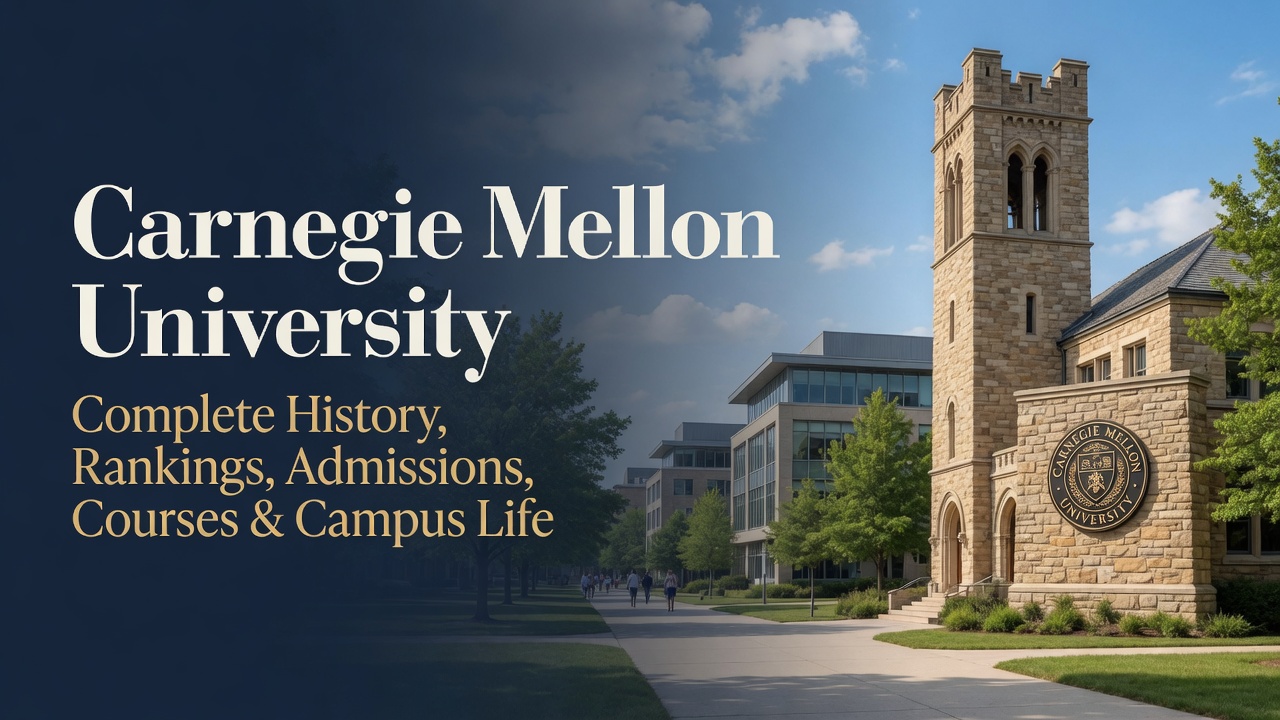
At CMU, the culture is defined by “The Persistent Pursuit of Excellence.” It is an institution where artists collaborate with software engineers and business leaders work alongside neuroscientists. This interdisciplinary environment is fostered by a university structure that encourages students to think beyond traditional academic silos, creating graduates who are prepared to lead in a technology-driven, globally connected world.
History & Heritage
CMU was formed by the merger of two institutions: the Carnegie Technical Schools, founded by philanthropist Andrew Carnegie in 1900, and the Mellon Institute of Industrial Research, founded by the Mellon brothers in 1913. These institutions merged in 1967 to create the modern Carnegie Mellon University, combining Carnegie’s commitment to technical education with the Mellon family’s dedication to industrial scientific research.
Throughout the 20th century, CMU became the “Birthplace of AI.” In the 1950s, Allen Newell and Herbert Simon developed the Logic Theorist, a foundational computer program in artificial intelligence. This set the trajectory for CMU’s dominance in the field, leading to the world’s first PhD in robotics and the establishment of the first Machine Learning department. Today, this heritage of “firsts”—from autonomous vehicles to the creation of the Java programming language—defines the university’s reputation.
Rankings & Global Reputation
Carnegie Mellon’s global reputation is built on its research output and its uncanny ability to solve real-world problems. It consistently ranks among the most prestigious technological institutions globally.
| Metric | Standing |
|---|---|
| U.S. News National Universities | Top 25 |
| QS World University Rankings | Top 60 |
| Subject Specialization | #1 in Artificial Intelligence, Software Engineering |
Academic Structure: The Colleges
CMU is structured into seven distinct colleges, each with a highly specialized admission process. Unlike many universities, you typically apply directly to the college or school that best fits your interests.
- School of Computer Science (SCS): Globally recognized as the gold standard for AI, machine learning, and human-computer interaction. It is famously difficult to enter, with acceptance rates often below 5%.
- College of Engineering: Known for its “bottom-up” approach to engineering, combining theoretical rigor with intensive, project-based laboratory work.
- Tepper School of Business: Pioneered the “Management Science” approach, integrating rigorous analytics and quantitative modeling into business decision-making.
- Dietrich College of Humanities and Social Sciences: A unique liberal arts college that integrates social science with data analytics and cognitive psychology.
- Mellon College of Science: Focuses on foundational research in physics, chemistry, biology, and mathematical sciences.
- College of Fine Arts: Highly selective programs in drama, music, architecture, design, and art, known for producing Broadway and Hollywood icons.
- Heinz College of Information Systems and Public Policy: A leader in the intersection of data-driven policy and information technology.
Admissions: The Strategy
Admission to CMU is highly strategic and competitive, with an overall acceptance rate hovering around 11%. However, as the university admits students directly into specific colleges, your “actual” acceptance rate depends entirely on your chosen major.
Admissions Tips:
- Demonstrate Technical Depth: CMU values substance over style. For STEM applicants, participation in high-level competitions (like USACO or Science Olympiad), open-source contributions, or original research projects is far more impressive than a resume of generic clubs.
- The “Maker” Mindset: Whether you are in the Fine Arts or the School of Computer Science, CMU looks for “makers”—people who build things, solve complex problems, and seek out new challenges.
- Portfolio/Maker Work: For the College of Fine Arts and even some STEM programs, a strong portfolio or showcase of “maker work” (independent projects) is highly encouraged to differentiate yourself from the thousands of other applicants with perfect grades.
Campus Life & Traditions
Life in Pittsburgh is a defining aspect of the CMU experience. Pittsburgh is a major tech hub (home to companies like Duolingo and Waymo), which provides CMU students with an unparalleled “laboratory” for internships and professional development.
Iconic Traditions:
- The Fence: The centerpiece of campus activism. Students paint it overnight to promote events, share messages, or celebrate milestones. It has famously held the title of the “most painted object in the world.”
- Spring Carnival: A three-day event featuring “Booth” (elaborate, student-built structures) and “Buggy,” where teams build aerodynamic, custom-built vehicles to race at high speeds across campus.
- Almost Midnight Breakfast: A beloved finals-week tradition where faculty and staff serve breakfast to students to fuel their last-minute study sessions.
Frequently Asked Questions