Introduction
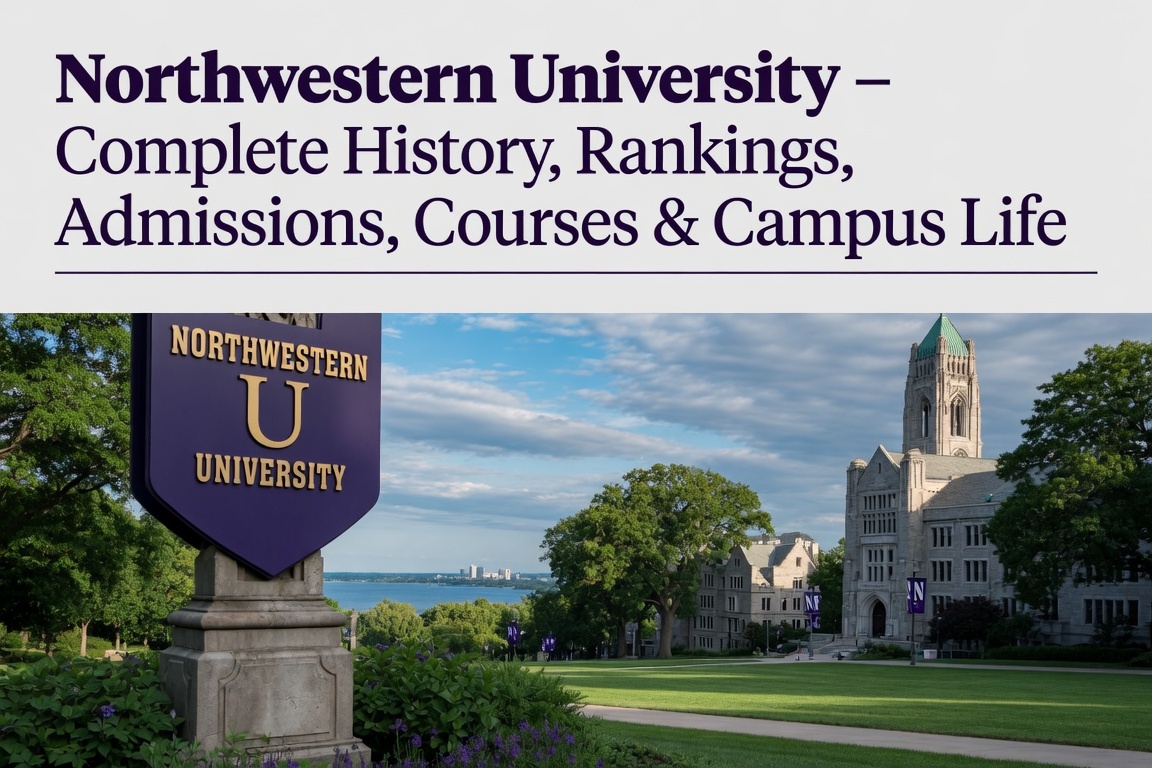
The university is perhaps most famous for its “interdisciplinary ethos.” At Northwestern, the boundaries between fields are intentionally blurred. Engineers study fine arts, journalists take courses in computer science, and business students engage with social policy. This philosophy prepares graduates not just for single-track careers, but for a dynamic global economy that demands multifaceted problem-solving skills.
A Detailed History
Northwestern was established by nine pioneers who sought to create a university for the Northwest Territory—the region that would become Ohio, Indiana, Illinois, Michigan, and Wisconsin. The founders, led by John Evans, purchased a 379-acre tract of land along the shores of Lake Michigan, which eventually became the city of Evanston, named in honor of Evans.
Founding & Growth (1851–1900)
The original university charter was passed by the Illinois legislature in 1851. In the early years, the institution focused on establishing a classical curriculum while struggling through the financial instability of the mid-19th century. By the 1890s, Northwestern had firmly established itself, helping to form the Big Ten Conference in 1896, which prioritized high academic standards alongside athletic competition.
The 20th Century & Professional Dominance
The 20th century saw the university expand its footprint into Chicago, establishing the medical, law, and business campuses that would eventually become globally recognized powerhouses. The mid-1900s marked a period of immense scientific and media influence, with the Medill School of Journalism becoming the industry benchmark for ethical reporting and the Kellogg School of Management pioneering the study of marketing and management science.
Rankings and Global Prestige
Northwestern consistently ranks among the top universities worldwide. Its excellence is broad, stretching from the humanities to medicine.
| Ranking Body | Standing |
|---|---|
| U.S. News National Universities | #7 |
| QS World University Rankings | #45 |
| Times Higher Education World | #24 |
| Kellogg School of Management (MBA) | Top 3 Globally |
| Medill School of Journalism | #1-3 in US |
Academic Schools and Programs
Northwestern operates via 12 schools and colleges, each maintaining a high degree of specialization while encouraging cross-campus collaboration.
Weinberg College of Arts and Sciences
The largest school at the university, providing the core liberal arts foundation. It is renowned for its research in economics, political science, and the humanities.
McCormick School of Engineering and Applied Science
Home to the “Whole-Brain Engineering” philosophy—a unique curriculum that integrates left-brain analytical thinking with right-brain creative design. It is a leader in computer science and industrial engineering.
Kellogg School of Management
One of the world’s premier business schools, Kellogg is famous for its collaborative culture and pioneering work in marketing and management strategy.
Medill School of Journalism, Media, Integrated Marketing Communications
Arguably the most famous journalism school in the US, Medill is known for its rigorous, real-world reporting and its leadership in digital media integration.
Pritzker School of Law
Consistently ranked in the top 12 in the US, Pritzker is renowned for its interdisciplinary focus and its prime location in downtown Chicago, offering unrivaled access to legal clerkships and major law firms.
Feinberg School of Medicine
A global leader in biomedical research and clinical training, Feinberg is a key driver of medical innovation in the Midwest.
Other Schools
The university also hosts the Bienen School of Music (conservatory-level arts), the School of Communication (famous for its strong alumni presence in Broadway and Hollywood), and the School of Education and Social Policy (SESP).
Admissions: The Competitive Landscape
Northwestern is extremely selective, with an acceptance rate typically hovering between 7% and 8%. The university employs a holistic review process, meaning that there is no “magic number” for SAT/ACT scores or GPA. Instead, the admissions committee looks for students who demonstrate genuine intellectual curiosity, a history of leadership, and the ability to contribute to the university’s interdisciplinary culture.
Early Decision (ED): Applying via Early Decision is highly encouraged for students who have Northwestern as their absolute first choice. The acceptance rate for ED is consistently higher than that for Regular Decision, as it indicates a firm commitment to the university’s values and community.
Campus Life: Traditions and Spirit
Northwestern’s campus culture is defined by its intensity—academically, creatively, and socially. Because the university operates on a **Quarter System** (three 10-week terms per year), the pace is fast, demanding a high level of organization and intellectual agility.
Signature Traditions:
- The Rock: A student-painted boulder that serves as a canvas for student activism, event promotion, and messages of solidarity. Camping out by the Rock to guard it is a classic tradition.
- Dillo Day: An annual, student-run music festival on the shores of Lake Michigan that features major musical headliners and attracts thousands of students.
- Dance Marathon: One of the longest-running student-led fundraisers, where students dance for 30+ hours to raise money for various charities.
- The Waa-Mu Show: A nearly century-old student-produced musical theater production that showcases the university’s deep talent pool in the performing arts.
FAQ: The Northwestern Experience