Introduction
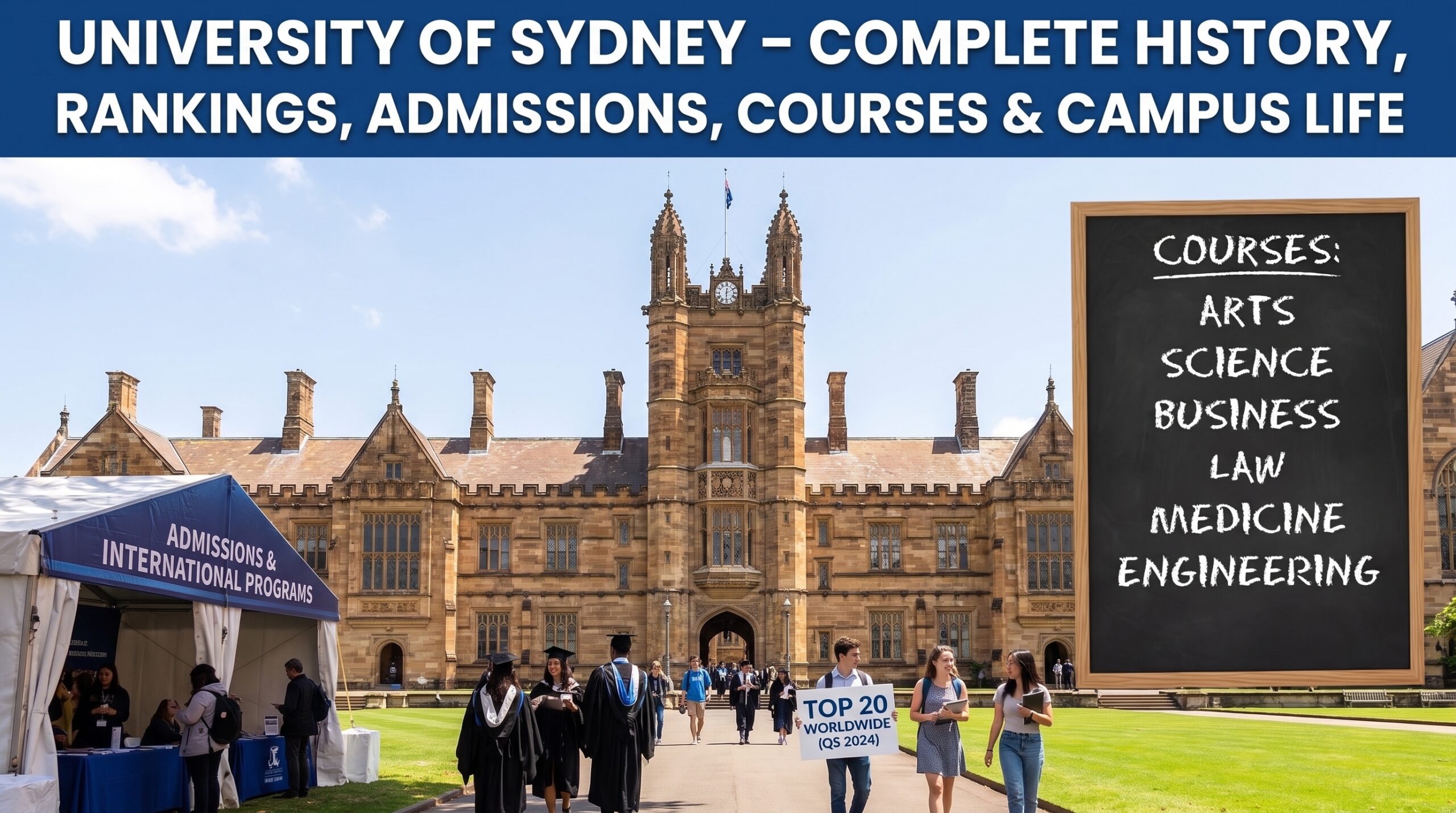
Known for its iconic neo-gothic sandstone buildings—most famously the Quadrangle which evokes the spirit of Oxbridge—the University of Sydney is a place where tradition meets cutting-edge innovation. It is a member of the prestigious Group of Eight (Go8), a coalition of Australia’s leading research universities, and it has consistently produced world leaders, Nobel laureates, and industry pioneers who have shaped the landscape of modern medicine, law, and the arts.
History & Legacy
The University of Sydney was founded by an Act of the New South Wales Parliament in 1850, born from the vision of colonial reformers like William Charles Wentworth, who championed a university accessible to all classes based on academic merit rather than social or religious status. It opened its doors to students in 1852 in the former Sydney College building, later moving to its current main campus at Camperdown/Darlington in 1855.
Over the past 175 years, the university has evolved into a global powerhouse. Its legacy is inextricably linked with Australia’s national development; it was the first university to admit women, and it has served as an intellectual incubator for seven Australian Prime Ministers, including Edmund Barton (the nation’s first) and Malcolm Turnbull. Its history is a testament to the pursuit of egalitarian education in a fledgling colony that grew into a modern, multicultural nation.
Global Rankings (2026/2027)
The University of Sydney maintains a dominant position in international rankings, reflecting its massive research output, academic reputation, and global social impact.
| Ranking Publication | Global Rank | National (Australia) Rank |
|---|---|---|
| QS World University Rankings 2027 | 22 | 2 |
| Times Higher Education (THE) 2026 | 29 | 2 |
| ARWU (Shanghai Ranking) 2025 | 38 | 2 |
“Sydney Uni consistently ranks in the top 0.5% of universities worldwide, a testament to its commitment to high-impact research and world-class graduate employability.”
Academic Structure
The University of Sydney is organized into several faculties and schools that cover a vast spectrum of disciplines. Its academic structure is designed to promote cross-disciplinary learning, particularly through the “Sydney Curriculum,” which emphasizes flexible degree structures and embedded internships.
Primary Faculties & Schools:
- Faculty of Arts and Social Sciences: A leader in humanities, offering world-class programs in politics, sociology, and international relations.
- Sydney Business School: Triple-accredited (AACSB, EQUIS, AMBA) and widely considered one of the top business schools in the Asia-Pacific region.
- Faculty of Medicine and Health: Home to innovative research in clinical medicine, public health, and nursing, with direct links to major teaching hospitals like Royal Prince Alfred.
- Faculty of Engineering: Renowned for its technological research in robotics, biomedical engineering, and sustainable energy solutions.
- Sydney Law School: Australia’s oldest law school, globally recognized for its influential research in international and commercial law.
- Sydney Conservatorium of Music: One of the oldest and most prestigious music institutions in Australia.
Admissions & Student Life
Admission to the University of Sydney is competitive, especially for courses like Medicine, Law, and Advanced Science. Selection is primarily merit-based, depending on the applicant’s prior secondary or tertiary qualifications.
Admissions Info:
- Domestic Students: Selection is based on the Australian Tertiary Admission Rank (ATAR). Many courses now offer “guaranteed” entry if a student meets the published ATAR threshold.
- International Students: Requirements vary by country; generally, applicants must meet specific grade thresholds in their national secondary examinations (or equivalent like IB/A-Levels) and provide proof of English language proficiency (e.g., IELTS, TOEFL).
Campus Life:
The Camperdown/Darlington campus is the university’s main site, spanning 72 hectares of greenery and historic architecture. It functions like a small city, complete with six libraries, museums, art galleries, and over 270 student-run clubs and societies. Whether it’s competing in “Inter-col” sports, participating in theatre, or grabbing a coffee at the famous Manning Bar, the student experience is as rich as the academic one.
Frequently Asked Questions