Introduction
Branding itself as “The Entrepreneurial University,” TUM operates with a philosophical framework that heavily distinguishes it from traditional, theory-obsessed European academic institutions. The university views fundamental scientific research not as an end in itself, but as the foundational step toward creating scalable technologies, spinning off startup companies, and partnering with massive industrial conglomerates. This pragmatic, industry-aligned approach has woven the university deeply into the fabric of the global economy, directly fueling the success of nearby industrial giants such as BMW, Siemens, and Audi.
With an academic structure that has recently undergone a radical, modernizing transformation into interdisciplinary “Schools,” TUM is aggressively expanding its footprint. Spanning across a historic main campus in Munich, a massive high-tech research hub in Garching, a life-sciences center in Weihenstephan, and even establishing a global presence in Singapore (TUM Asia), the university operates on an immense scale. This comprehensive guide details TUM’s illustrious history, its breathtaking physical infrastructure, its increasingly competitive global admissions landscape (including recent, historic changes to tuition policies), and the vibrant, innovation-obsessed student life that thrives in the shadow of the Bavarian Alps.
The Comprehensive History of TUM
Founding and the Industrial Revolution (1868)
The origins of TUM are directly tied to the rapid industrialization of 19th-century Europe. While classical German universities focused on theology, law, and philosophy, the Kingdom of Bavaria recognized an urgent need for an institution dedicated strictly to the applied sciences and engineering to compete with the industrial might of Britain and Prussia. In 1868, King Ludwig II of Bavaria founded the *Polytechnische Schule München* (Polytechnic School of Munich).
The institution was designed to train the architects, mechanical engineers, and chemists needed to build railways, design factories, and modernize agriculture. It was an immediate success, rapidly outgrowing its initial mandate. By 1877, recognizing its academic rigor, it was renamed the *Technische Hochschule München* (THM). During this early golden era, the university served as the intellectual home for some of the greatest innovators in history, including Carl von Linde, who invented modern refrigeration technology while serving as a professor, and Rudolf Diesel, the inventor of the diesel engine, who studied thermodynamics under Linde.
World War II and Reconstruction
The dark chapter of the Second World War brought catastrophe to the university. During the Allied bombing campaigns over Munich, the main campus in the city center was heavily targeted due to its importance to the German industrial and military apparatus. By the end of the war in 1945, approximately 80% of the university’s buildings lay in ruins, and the institution was forced to suspend teaching entirely.
The postwar reconstruction was a monumental, grueling effort spearheaded by returning faculty and students, many of whom literally cleared the rubble by hand. The university reopened in 1946. This era of rebuilding forged a resilient, pragmatic institutional character. In 1956, the university launched a new era of scientific ambition with the construction of the FRM (Forschungsreaktor München), the first nuclear research reactor in Germany, located in Garching. This facility, famous for its distinct egg-shaped dome (the “Atomic Egg”), catalyzed the transformation of Garching into one of the largest scientific research campuses in Europe.
Transformation into “The Entrepreneurial University” (1970s–Present)
In 1970, the institution was officially renamed the *Technische Universität München* (TUM), reflecting its evolution into a fully comprehensive research university that integrated medicine, natural sciences, and later, business and management, alongside its traditional engineering core.
Under the visionary, transformative presidency of Wolfgang A. Herrmann (who served from 1995 to 2019, making him the longest-serving university president in Germany), TUM abandoned the rigid, bureaucratic structures typical of German state universities. Herrmann rebranded TUM as “The Entrepreneurial University,” heavily promoting technology transfer, English-taught master’s programs, and massive fundraising campaigns. In 2006, 2012, and 2019, TUM consistently won the highly coveted “University of Excellence” status from the German federal government, securing hundreds of millions of euros in extra funding and cementing its absolute dominance in the German academic landscape.
Campus Locations and Architectural Highlights
TUM operates as a massive, decentralized academic network. Unlike American universities built around a single, unified quadrangle, TUM’s facilities are strategically distributed across several distinct campuses in the Munich metropolitan area and beyond, each tailored to specific scientific disciplines.
Munich City Campus (Main Campus)
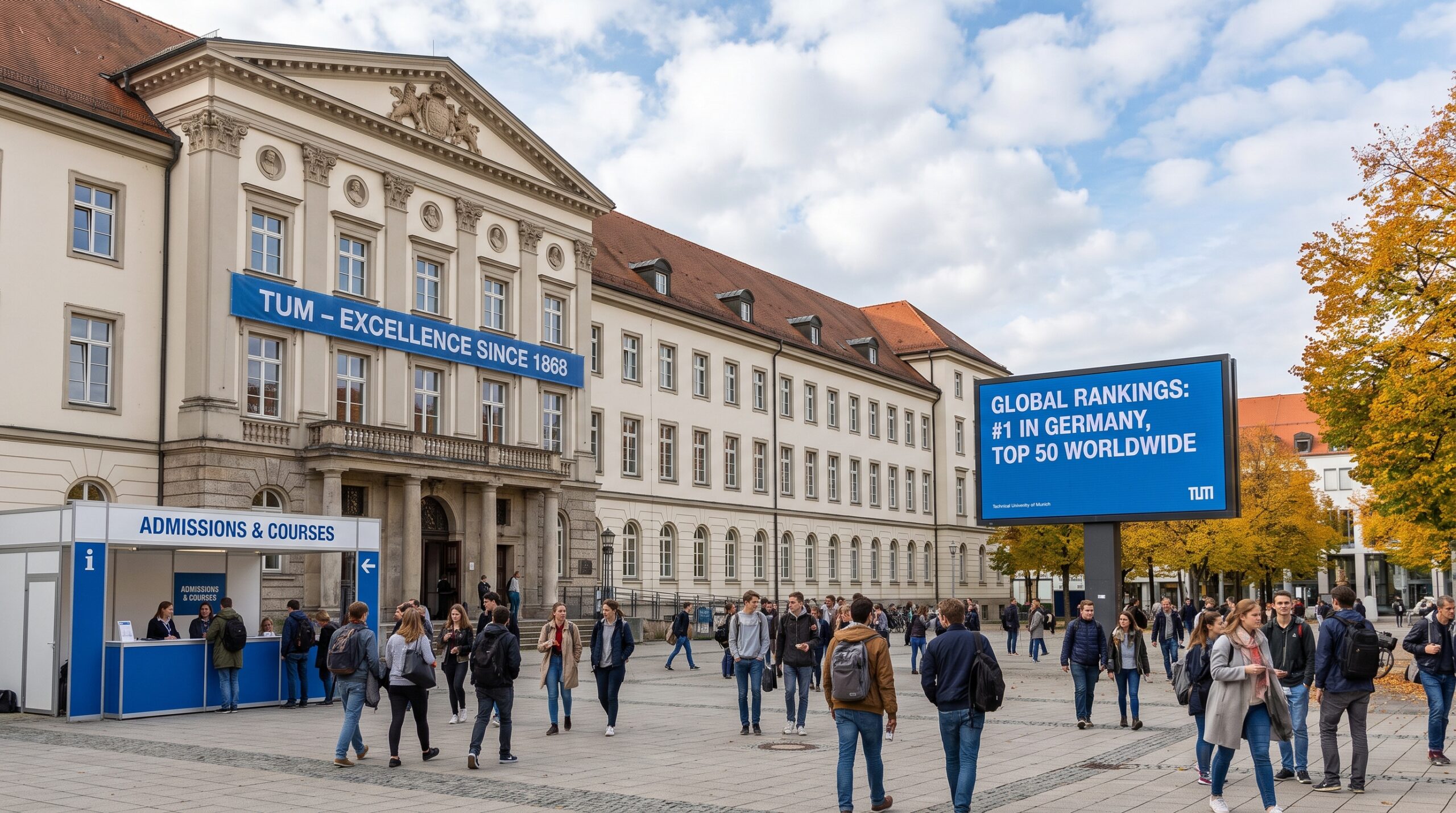
The historical heart of the university is located in the Maxvorstadt district of central Munich, directly adjacent to the city’s world-famous museum quarter (the Pinakotheken). The architecture is a fascinating blend of restored 19th-century neoclassical facades and functional, post-war modernism. The Munich campus houses the administration, the School of Management, the School of Social Sciences and Technology, and the departments of Architecture and Civil Engineering. It is heavily integrated into the city, with students frequently studying in the nearby Englischer Garten or gathering in traditional Bavarian beer gardens after lectures.
Garching Campus (Science and Engineering Hub)
Located about 15 kilometers north of Munich, the Garching campus is a colossal, futuristic complex dedicated to physics, chemistry, mechanical engineering, mathematics, and computer science. It is one of the largest centers for research and teaching in Europe. The campus is directly serviced by the Munich U-Bahn (subway), terminating at the “Garching-Forschungszentrum” station.
Garching features incredible architectural quirks and scientific landmarks. The Magistrale (the main hallway of the Mathematics and Informatics building) famously features two massive, multi-story parabolic slides that students use to rapidly descend from the upper floors to the ground level—a physical manifestation of the university’s playful approach to physics. The campus also houses the modern FRM II, one of the world’s most advanced high-flux neutron research reactors, utilized for cutting-edge materials science and medical research.
Weihenstephan Campus (Life Sciences)
Situated in the picturesque town of Freising, about 35 kilometers north of Munich, the Weihenstephan campus is explicitly dedicated to the Life Sciences: agronomy, biology, forestry, nutrition, and landscape design. The campus is stunning, nestled on a hill overlooking the Bavarian countryside. Uniquely, it is also globally famous for its association with the Bayerische Staatsbrauerei Weihenstephan, the oldest continuously operating brewery in the world (founded in 1040). TUM students literally study the science of brewing here, graduating as master brewers heavily recruited by the global beverage industry.
Straubing, Heilbronn, and Global Hubs
In recent years, TUM has expanded aggressively. The Straubing campus focuses entirely on biotechnology and sustainability. The Heilbronn campus, funded heavily by the Dieter Schwarz Foundation, focuses on the management of digital technologies and family businesses. Internationally, TUM Asia in Singapore serves as the university’s gateway to the Asian tech market, offering specialized master’s degrees in collaboration with the National University of Singapore (NUS) and Nanyang Technological University (NTU).
Academic Structure: The Transition to Schools
Historically, German universities were rigidly divided into highly autonomous, siloed “Faculties.” Recognizing that modern scientific breakthroughs require massive interdisciplinary collaboration, TUM initiated a radical, historic restructuring known as the “TUM Agenda 2030.” The university dissolved its traditional faculties and merged them into massive, matrix-style “Schools,” modeled after top-tier American institutions.
TUM School of Engineering and Design
This is the historic core of the university, combining aerospace, civil, mechanical, and environmental engineering, alongside architecture. It is an absolute powerhouse of applied technology. Students here design hyperloop pods, sustainable urban infrastructure, and next-generation robotics. The school works in intimate partnership with companies like Airbus, BMW, and Siemens, ensuring that the curriculum remains highly relevant to global industry demands.
TUM School of Computation, Information and Technology (CIT)
The CIT School represents the merger of mathematics, computer science, and electrical engineering. Based primarily in Garching, it is arguably the most prestigious computer science hub in Europe. The school leads global research in artificial intelligence, quantum computing, cybersecurity, and telecommunications. Graduates from CIT are fiercely recruited by the global tech industry, with Munich serving as a massive European hub for companies like Google, Microsoft, and Apple.
TUM School of Natural Sciences
Housing the disciplines of physics, chemistry, and biosciences, this school operates as the fundamental research engine of the university. Utilizing the FRM II neutron source and numerous Max Planck Institutes located directly on the Garching campus, researchers here explore everything from subatomic particle physics and dark matter to the development of novel catalysts for green energy storage.
TUM School of Management
The TUM School of Management operates at the intersection of management and technology. Unlike traditional business schools, TUM requires its management students to take substantial coursework in engineering or natural sciences. This creates a unique breed of graduates: business leaders who actually understand the deeply technical products they are marketing or managing. The school boasts triple-crown accreditation (AMBA, EQUIS, AACSB), a highly coveted distinction held by only a fraction of business schools globally.
TUM School of Medicine and Health
Operating the university hospital, *Klinikum rechts der Isar*, this school is a titan of medical research and clinical care. It is globally renowned for its advancements in oncology, neurology, and medical engineering. Uniquely, the school collaborates heavily with the engineering departments to pioneer robotic surgery, advanced neuro-prosthetics, and cutting-edge medical imaging technologies.
Admissions, Selectivity, and International Tuition Fees
The German System and Aptitude Assessment
The admissions process at TUM differs significantly from the holistic, essay-driven models of American or British universities. Like all German public universities, admission is primarily determined by objective, mathematical academic performance. For domestic students, the primary metric is the *Abitur* (the highly rigorous German secondary school leaving certificate). However, because TUM is vastly oversubscribed, it does not rely solely on a minimum *Numerus Clausus* (NC) cutoff grade.
Instead, TUM utilizes a highly specific Aptitude Assessment Procedure (*Eignungsfeststellungsverfahren* or EfV) for most of its degree programs. This multi-stage process evaluates an applicant’s grades—giving higher weight to subjects directly relevant to the chosen degree, such as mathematics and physics for engineering—and often requires a specialized motivational essay. If an applicant’s initial score is borderline, they are invited to a rigorous, subject-specific oral interview with TUM professors to determine their aptitude for the field.
Language Requirements and English-Taught Programs
While the majority of undergraduate (Bachelor’s) programs at TUM are taught entirely in German—requiring international applicants to prove high-level proficiency through standardized tests like the TestDaF or DSH—the university has aggressively internationalized its postgraduate offerings. Today, the vast majority of Master’s programs and nearly all Ph.D. programs at TUM are taught entirely in English. This strategic shift has resulted in a massively diverse student body, with international students currently comprising over 40% of the total enrollment.
Historic Shift: Tuition Fees for Non-EU Students
For decades, higher education in Bavaria was completely free for all students, regardless of nationality. However, in a monumental and highly debated policy shift, TUM introduced tuition fees for international students from third countries (non-EU/EEA citizens) beginning in the Winter Semester of 2024/25. This was implemented to cover the massive costs of maintaining world-class research infrastructure and expanding student services.
The new fee structure is highly competitive compared to UK or US institutions but represents a significant change for Germany. Depending on the specific program, tuition for non-EU students typically ranges from **€2,000 to €3,000 per semester for Bachelor’s degrees**, and **€4,000 to €6,000 per semester for Master’s degrees**. It is critical to note that German citizens, EU/EEA citizens, and international students who obtained their university entrance qualification within the German educational system remain entirely exempt from these tuition fees, paying only the standard nominal semester contribution (approx. €85 – €100) for student union and transit fees.
University Rankings and Global Reputation
TUM’s aggressive modernization, massive industrial partnerships, and relentless focus on technological innovation have cemented its status as the absolute best university in Germany and a top-tier global institution.
Institutional Rankings (2025–2026)
| Ranking Publication | Global Rank | National (Germany) Rank | European Rank |
|---|---|---|---|
| QS World University Rankings | 37 | 1 | 10 |
| Times Higher Education (THE) | 30 | 1 | 8 |
| Academic Ranking of World Universities (ARWU) | 59 | 1 | 17 |
| Global University Employability Ranking (THE) | 13 | 1 | 4 |
Global Employability and Entrepreneurship
Perhaps the most critical metric for TUM is the Global University Employability Ranking, where it consistently ranks within the top 15 worldwide, frequently outperforming elite Ivy League institutions. Global recruiters actively target TUM graduates for their unparalleled technical competence and practical problem-solving abilities. Furthermore, in specialized rankings for entrepreneurship and unicorn-startup generation, TUM is universally recognized as the premier startup incubator in continental Europe.
Campus Life, Student Culture, and Entrepreneurship
The student experience at TUM is characterized by intense academic rigor, balanced by a highly active ecosystem of student-led engineering initiatives and the unparalleled cultural backdrop of the Bavarian capital.
UnternehmerTUM: The Startup Machine
The defining feature of extracurricular life at TUM is **UnternehmerTUM**, the Center for Innovation and Business Creation. It is the largest university-based center for startups in Europe. Offering massive maker-spaces (the “MakerSpace” in Garching is a 1,500-square-meter high-tech workshop open to students), venture capital access, and intense mentorship, it actively turns student projects into viable commercial enterprises. Decacorn companies like **Celonis** (process mining software) and highly funded mobility startups like **Lilium** (electric vertical takeoff jets) were spun directly out of TUM classrooms via this ecosystem.
Student Initiatives: Hyperloop and TUfast
TUM students do not merely study engineering; they aggressively compete on the global stage. The **TUM Hyperloop** team gained global fame by winning Elon Musk’s SpaceX Hyperloop Pod Competition four times in a row, consistently breaking world speed records for sub-scale prototype pods. The **TUfast** racing team designs, builds, and races high-performance electric and autonomous Formula Student vehicles, frequently dominating European engineering competitions. The **WARR** (Scientific Workgroup for Rocketry and Spaceflight) launches student-built rockets and operates a space elevator team. These initiatives demand a massive time commitment but function as the ultimate proving ground for the world’s best young engineers.
Munich City Life and the Oktoberfest
Living in Munich provides an exceptionally high quality of life. The city is impeccably clean, incredibly safe, and boasts a massive public transit system (MVV). It is a tech hub, but deeply traditional. For two weeks in late September, the academic calendar unofficially bows to the **Oktoberfest** (the *Wiesn*). It is a massive cultural event where TUM students, faculty, and alumni don traditional Bavarian *Lederhosen* and *Dirndls* to celebrate in the massive beer tents, a beloved tradition that perfectly encapsulates the university’s “work hard, play hard” mentality.
Notable Alumni and Faculty Legacy
The human output of TUM has fundamentally altered the trajectory of modern global technology, physics, and heavy industry. As of the 2020s, nearly 20 Nobel Laureates have been affiliated with the university.
Industrial Pioneers
The university’s early alumni literally built modern industry. **Carl von Linde** (inventor of modern refrigeration), **Rudolf Diesel** (inventor of the diesel engine), and **Claude Dornier** (aviation pioneer) all studied or taught at TUM. In the modern era, top executives who have shaped the German automotive and industrial sectors frequently hold TUM degrees, including numerous former and current CEOs of BMW, Siemens, and Linde plc.
Nobel Laureates and Scientific Titans
TUM’s scientific legacy is monumental. **Joachim Frank** won the 2017 Nobel Prize in Chemistry for developing cryo-electron microscopy. **Wolfgang Paul** won the Nobel Prize in Physics for developing the ion trap (the Paul trap). **Rudolf Mößbauer** discovered the Mössbauer effect (recoilless nuclear resonance fluorescence), earning the Nobel Prize in Physics. In literature, the university proudly claims the legendary author **Thomas Mann**, who studied at the university before writing masterpieces like *The Magic Mountain*.
Records & Achievements
- University of Excellence: One of the only German universities to consistently win the highly competitive “Excellence Initiative” funding from the federal government in every single round since 2006.
- Unicorn Generator: The premier university in Germany for producing billion-dollar startup companies (Unicorns), including Celonis, Lilium, and Personio, driven by the UnternehmerTUM ecosystem.
- SpaceX Hyperloop Champions: The TUM student team won the SpaceX Hyperloop Pod Competition four consecutive times, achieving a world-record top speed of 463 km/h (288 mph).
- The Atomic Egg: Site of the FRM, Germany’s very first nuclear research reactor, which catalyzed the massive scientific expansion of the Garching campus.
- Global Employability: Consistently ranked as the #1 university in Germany and among the top 15 globally for producing the most highly employable, industry-ready graduates.
Frequently Asked Questions (FAQ)