Introduction
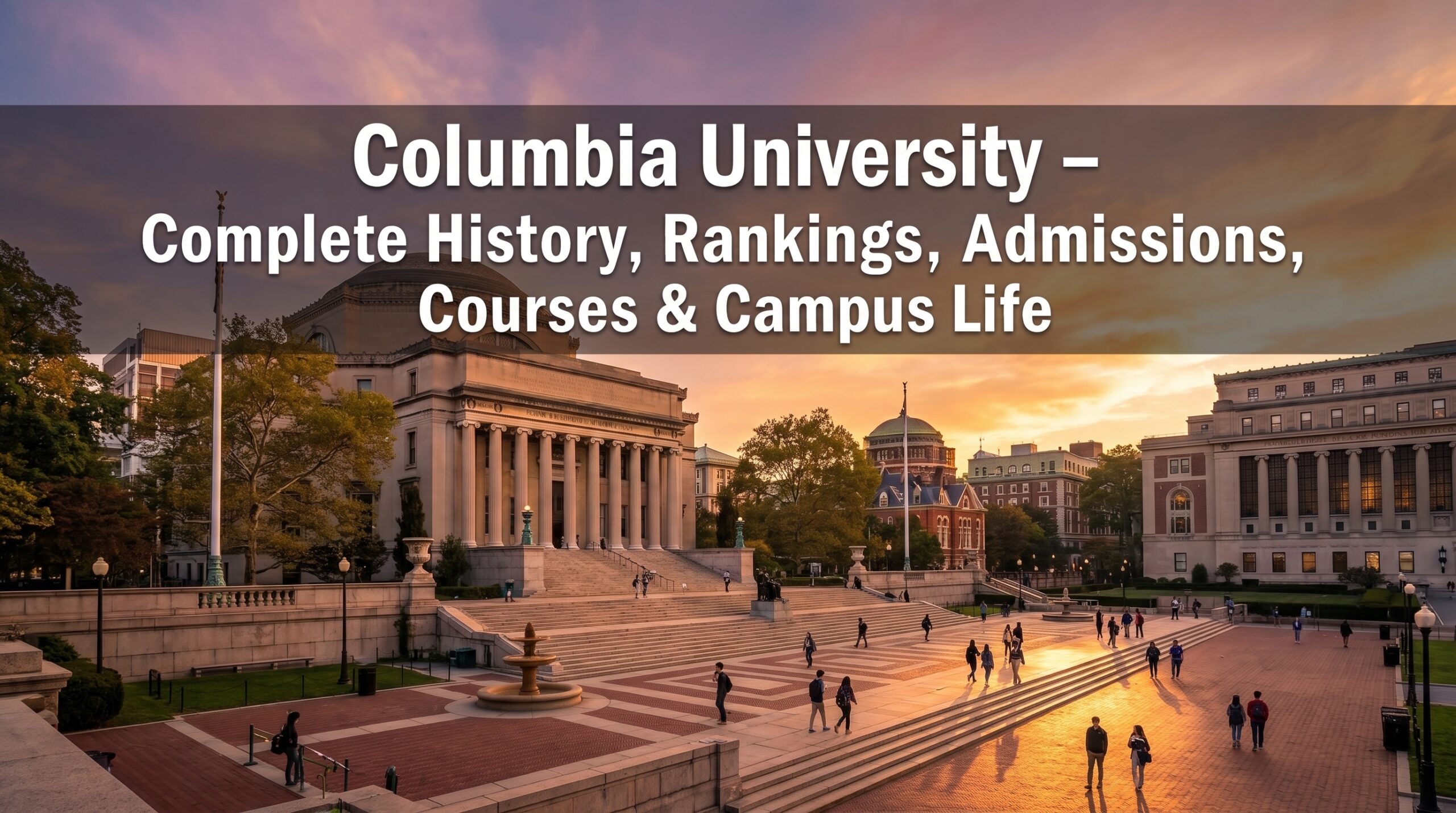
The defining characteristic of Columbia is its unique synthesis of the cloistered academy and the urban environment. Its stunning Beaux-Arts campus in Morningside Heights provides a serene, neoclassical sanctuary that contrasts sharply with the relentless, kinetic energy of Manhattan surrounding it. This geographic advantage has historically transformed the university into the epicenter of monumental global events—from the invention of the FM radio and the birth of the Manhattan Project to the founding of the Pulitzer Prize and the ignition of the 1968 student protest movements that defined a generation.
At the undergraduate level, Columbia is globally renowned for its legendary Core Curriculum, a mandatory, intensive sequence of courses that ensures every student grapples with the foundational texts of Western philosophy, literature, and art. At the graduate and professional levels, its schools of law, business, journalism, and medicine dictate the trajectory of their respective industries worldwide. This comprehensive biography of Columbia University delves into its dramatic historical evolution, dissects its unparalleled academic structure, explores the nuances of its highly selective admissions process, and paints a vivid picture of the relentless, highly spirited campus life that beats within the heart of New York City.
The Comprehensive History of Columbia University
King’s College and the Colonial Era (1754–1776)
The origins of Columbia University reflect the intense religious and political rivalries of colonial America. In 1754, responding to the founding of the College of New Jersey (now Princeton University) by New Light Presbyterians, the establishment figures of the Province of New York sought to create an Anglican counterpart. King George II of Great Britain granted a royal charter establishing “King’s College.” The first classes were held in a humble schoolhouse adjoining Trinity Church in lower Manhattan, with Samuel Johnson serving as the first president and sole instructor to a class of merely eight students.
Despite its small size, King’s College immediately attracted the elite of colonial society. Its early student body included individuals who would become the architectural minds of the United States, including Alexander Hamilton, John Jay, Gouverneur Morris, and Robert R. Livingston. However, the escalating tensions of the American Revolution soon engulfed the college. Due to its royalist leanings and the occupation of New York City by British forces, instruction was suspended in 1776, and the college building was commandeered as a military hospital, abruptly halting its academic operations.
The American Revolution and Renaming (1784–1857)
Following the conclusion of the Revolutionary War and the establishment of American independence, the institution required a massive ideological and structural rebirth. In 1784, the New York State Legislature reopened the college, deliberately severing its royalist ties by renaming it “Columbia College”—a patriotic, neoclassical term symbolizing the new American republic. Alexander Hamilton and John Jay were highly instrumental in this revitalization, serving on the newly formed Board of Regents.
Throughout the early 19th century, Columbia expanded its academic offerings, though it remained a relatively small, localized institution compared to its New England peers. In 1767, before the war, it had already established the first medical school in the American colonies to grant the Doctor of Medicine (M.D.) degree. The Law School was formally established in 1858. Recognizing that the rapidly industrializing nation required advanced scientific instruction, the School of Mines (now the Fu Foundation School of Engineering and Applied Science) was founded in 1864, the first of its kind in the United States.
The Move to Morningside Heights (1897)
By the mid-19th century, as Manhattan rapidly urbanized and expanded northward, Columbia’s campus in lower Manhattan became increasingly cramped. In 1857, the college relocated to a temporary site at 49th Street and Madison Avenue. However, it was under the visionary leadership of President Seth Low in the late 19th century that Columbia secured its permanent, iconic home.
Low acquired a massive tract of land in Morningside Heights, a rocky, elevated neighborhood in upper Manhattan that previously housed the Bloomingdale Insane Asylum. He commissioned the legendary architectural firm McKim, Mead & White to design a sweeping, neoclassical campus that would reflect the university’s transition from a regional college into a comprehensive, world-class research university. The campus officially opened in 1897. Concurrently, the institution was officially renamed “Columbia University,” acknowledging its expansive collection of graduate and professional schools.
The 20th Century: The Manhattan Project and 1968 Protests
During the 20th century, Columbia solidified its status as a global research titan. In the 1930s and 1940s, the university became the epicenter of early nuclear research. Scientists including Enrico Fermi, Leo Szilard, and John Dunning conducted groundbreaking experiments on uranium fission in the basement of Pupin Hall, laying the intellectual groundwork for the Manhattan Project and the dawn of the atomic age.
The cultural upheavals of the 1960s struck Columbia with profound force. In April 1968, the campus erupted in massive student protests. The demonstrations were triggered by two highly contentious issues: the university’s ties to the Institute for Defense Analyses (IDA) during the Vietnam War, and the proposed construction of a controversial gymnasium in the adjacent, predominantly Black neighborhood of Morningside Park, which featured segregated entrances. Students occupied multiple administrative buildings, including Low Library and Hamilton Hall, holding the acting dean hostage. The crisis culminated in a violent police raid, resulting in hundreds of arrests. The 1968 protests fundamentally altered the university’s governance, deeply influencing student activism nationwide and forcing the institution to reevaluate its relationship with the surrounding Harlem community.
The 21st Century: Global Expansion and Manhattanville
In the modern era, under the prolonged presidency of Lee C. Bollinger, Columbia has focused on aggressive physical and global expansion. Recognizing the space constraints of the Morningside Heights campus, the university embarked on a monumental, multibillion-dollar expansion project into the nearby Manhattanville neighborhood. This new, open-concept campus, designed predominantly by Pritzker Prize-winning architect Renzo Piano, focuses on interdisciplinary scientific research, business, and the arts, ensuring that Columbia remains physically capable of competing with its sprawling Ivy League peers well into the 21st century.
Campus Architecture and Landmarks
The physical environment of Columbia University is a masterpiece of urban planning. The Morningside Heights campus was intentionally designed as an “academical village” insulated from, yet integrated with, the relentless grid of Manhattan.
The Beaux-Arts Masterpiece: Low Memorial Library
The architectural and spiritual center of the Morningside Heights campus is Low Memorial Library. Designed by Charles Follen McKim and completed in 1895, it is modeled after the Roman Pantheon. Featuring a massive limestone dome and an imposing flight of steps leading to an ionic colonnade, it is a quintessential example of American Beaux-Arts architecture. Although it no longer functions as the primary library (it now houses central administration), its grand plaza, affectionately known as “Low Steps,” serves as the premier social gathering space for the student body. Presiding over the steps is the iconic bronze statue of Alma Mater, sculpted by Daniel Chester French, featuring a hidden owl hidden in the folds of her robes, which has become a legendary symbol of the university.
Butler Library
Directly facing Low Library across the main campus quadrangle (South Lawn) is Butler Library. Completed in 1934 and designed by James Gamble Rogers, Butler is the university’s primary library and one of the largest academic buildings in the nation, housing over 2 million volumes. Its imposing facade is famous for the names of great writers, philosophers, and thinkers inscribed across its frieze—including Homer, Herodotus, Sophocles, Plato, Aristotle, and Dante. It operates as the intense, high-pressure study hub for undergraduates, with its majestic reference room open 24 hours a day.
The Manhattanville Campus Expansion
Representing the future of Columbia’s architectural identity, the Manhattanville campus, located a few blocks north of Morningside Heights, is a radical departure from the enclosed, neoclassical design of the main campus. Master-planned by Renzo Piano, the campus features sheer, transparent glass facades designed to invite the local community in, rather than walling them out. The crown jewel of this expansion is the Jerome L. Greene Science Center, a state-of-the-art facility dedicated strictly to neuroscience research and the Mortimer B. Zuckerman Mind Brain Behavior Institute.
Academic Structure and Major Schools
Columbia operates as a highly decentralized but deeply interconnected research university, consisting of three primary undergraduate schools and fourteen distinct graduate and professional schools, along with significant affiliated institutions.
Columbia College (CC)
Columbia College is the oldest and most traditional undergraduate division of the university. Offering a pure liberal arts education to approximately 4,700 students, it is deeply defined by the Core Curriculum. Students in CC are heavily integrated into the vibrant intellectual tradition of the university, pursuing Bachelor of Arts degrees across the humanities, social sciences, and natural sciences while engaging deeply with the cultural resources of New York City.
The Fu Foundation School of Engineering and Applied Science (SEAS)
SEAS offers a uniquely rigorous engineering education embedded within a premier liberal arts university. Undergraduate engineering students are also required to take a modified, condensed version of the Core Curriculum. This ensures that Columbia engineers graduate not only with exceptional technical proficiency but with a profound humanistic and ethical understanding of how their technology impacts global society. SEAS is renowned for its research in biomedical engineering, applied mathematics, and computer science.
School of General Studies (GS)
The School of General Studies is highly unique among the Ivy League. It is an elite, fully integrated undergraduate college specifically designed for non-traditional students—those who have had an educational break of a year or more. The GS student body consists of military veterans, professional ballet dancers, Olympic athletes, actors, and career-changers. GS students take the exact same classes with the exact same professors as Columbia College students, adding an unparalleled layer of maturity, life experience, and diversity to the classroom dynamic.
Columbia Law School
Consistently ranked within the top 5 law schools in the United States, Columbia Law is famously known as the premier training ground for corporate law and international jurisprudence. Located in Jerome L. Greene Hall, the school boasts an alumni network that heavily populates the highest echelons of the Supreme Court, the federal judiciary, and “Big Law” firms in Manhattan and globally. Notable alumni include Presidents Theodore and Franklin D. Roosevelt, and Supreme Court Justice Ruth Bader Ginsburg.
Columbia Business School (CBS)
Operating out of stunning new facilities in the Manhattanville campus (David Geffen Hall and Henry R. Kravis Hall), CBS leverages its location in the financial capital of the world. The school heavily emphasizes “value investing”—a methodology pioneered at Columbia by Benjamin Graham and David Dodd, and famously utilized by their most successful student, Warren Buffett. CBS offers unparalleled access to Wall Street, with top executives frequently serving as adjunct professors.
Vagelos College of Physicians and Surgeons (VP&S)
Operating in conjunction with the NewYork-Presbyterian Hospital in the Washington Heights neighborhood, VP&S is one of the premier medical schools in the world. It famously became the first medical school in the United States to replace all student loans with scholarships for all students who qualify for financial aid, a groundbreaking move endowed by P. Roy Vagelos. The school is globally recognized for its monumental breakthroughs in neuroscience, cardiology, and oncology.
Columbia Journalism School
Founded by a massive endowment from newspaper magnate Joseph Pulitzer in 1912, the Journalism School is arguably the most prestigious in the world. It exclusively offers graduate degrees and operates intensely rigorous, boot-camp-style programs that train reporters for the digital age. Most notably, the school is the administrative home of the Pulitzer Prizes, the highest honor in American journalism, literature, and musical composition.
School of International and Public Affairs (SIPA)
SIPA is a world-renowned graduate school focusing on global policy, international finance, and human rights. Leveraging its proximity to the United Nations headquarters in Manhattan, SIPA trains future diplomats, intelligence officials, and NGO leaders. The faculty features a staggering array of former heads of state, ambassadors, and central bankers, ensuring that students learn global policy directly from those who drafted it.
Notable Courses and Signature Academic Programs
The Legendary Core Curriculum
The Core Curriculum is the pedagogical cornerstone of undergraduate life at Columbia, distinguishing it heavily from the open-curriculum systems of peers like Brown or the distributional requirements of Yale. Implemented in 1919 following World War I, the Core is designed to provide all students, regardless of their major, with a shared, intensive intellectual foundation. It consists of small, discussion-based seminars (capped at 22 students) that force students to grapple with the most influential, challenging texts in Western history.
- Literature Humanities (Lit Hum): A year-long freshman course covering masterpieces of Western literature, ranging from Homer’s Iliad and Aeschylus’s Oresteia to Sappho, Dante, Cervantes, and Virginia Woolf.
- Contemporary Civilization (CC): A year-long sophomore course examining the evolution of political and moral philosophy, analyzing texts by Plato, Aristotle, Machiavelli, Hobbes, Locke, Rousseau, Kant, and Marx.
- Art Humanities & Music Humanities: Intensive semester-long courses that train students to critically analyze Western art and classical music, frequently utilizing the unparalleled cultural resources of New York City (e.g., mandatory visits to the Metropolitan Museum of Art or the New York Philharmonic).
- Frontiers of Science & University Writing: Modern additions to the Core that ensure students possess rigorous analytical reasoning and elite compositional skills.
The Core Curriculum acts as a great equalizer; a computer science prodigy and an English literature major will sit across from each other in a seminar room and debate the ethics of the French Revolution or the morality of the Bhagavad Gita. This shared academic trial by fire forms a profound, lifelong intellectual bond among all Columbia alumni.
Dual B.A. Degree Programs
Through the School of General Studies, Columbia has pioneered a series of innovative Dual B.A. programs that represent the frontier of globalized undergraduate education. Students spend their first two years at an elite international partner institution—such as Sciences Po in France, Trinity College Dublin in Ireland, or Tel Aviv University in Israel—and their final two years at Columbia. Graduates receive two separate bachelor’s degrees, perfectly blending distinct cultural and academic methodologies while mastering multiple languages.
Admissions, Selectivity, and Financial Aid
The Admissions Landscape (2025–2026 Data)
Gaining admission to Columbia University remains an extraordinarily daunting task, reflecting its status as one of the most coveted educational institutions globally. The sheer allure of an Ivy League education located in the heart of Manhattan consistently generates massive application volumes. For the academic cycles encompassing the Class of 2028 and 2029, Columbia regularly received over 60,000 applications for an incoming freshman class of approximately 1,500 students.
The overall acceptance rate has consistently hovered between 3.8% and 4.2%, placing Columbia among the three most selective universities in the United States. Columbia operates an Early Decision (ED) program, which is binding. The acceptance rate for the ED round is typically significantly higher, usually ranging between 11% and 13%, rewarding applicants who commit definitively to attending if admitted. The Regular Decision round is brutally competitive, with acceptance rates often dipping below 3%.
Testing Policies and Academic Profiles
In a major shift distinguishing it from several Ivy League peers, Columbia University became the first highly selective institution to announce a permanent “test-optional” policy for undergraduate admissions, extending the pandemic-era policy indefinitely. Applicants are not required to submit SAT or ACT scores, and those who choose not to do so are not penalized. However, for those who do submit, the middle 50% range is staggeringly high, typically falling between 1500–1560 on the SAT and 34–35 on the ACT.
Because standardized testing is optional, the admissions committee relies heavily on the rigor of the high school transcript, profound extracurricular impact, highly personal letters of recommendation, and the applicant’s essays. Columbia places particular emphasis on intellectual curiosity and alignment with the Core Curriculum; applicants are famously required to list the books, films, and media they have consumed outside of mandatory coursework, providing the admissions team with a window into their independent intellectual life.
Financial Aid and The Columbia Commitment
Columbia is strictly “need-blind” for all U.S. citizens and permanent residents, meaning the ability to pay does not factor into the admissions decision. The university meets 100% of demonstrated financial need for all admitted first-year students without incorporating loans into the financial aid packages. The aid is provided entirely through grants and work-study.
Under the enhanced financial aid initiatives, families with total incomes below $66,000 are not expected to contribute anything toward the cost of tuition, room, board, and mandatory fees. This monumental financial commitment ensures that a Columbia education is accessible to the brightest students in the world, completely regardless of their socioeconomic background.
University Rankings and Global Reputation
Columbia University is universally recognized as a top-tier global research institution. While ranking methodologies occasionally cause slight fluctuations, Columbia’s massive research output, elite faculty, and historical prestige ensure its permanent status among the world’s finest universities.
Institutional Rankings (2025–2026)
| Ranking Publication | Global Rank | National (US) Rank |
|---|---|---|
| U.S. News & World Report | 9 | 12 |
| Times Higher Education (THE) | 15 | 11 |
| QS World University Rankings | 23 | – |
| Academic Ranking of World Universities (ARWU) | 8 | 8 |
| Center for World University Rankings (CWUR) | 7 | 6 |
Subject-Specific Excellence
Beyond broad institutional scores, Columbia dominates across highly specific disciplines. The Columbia Law School is a permanent fixture in the top 5 nationwide. The Columbia Business School routinely ranks among the top 10 globally for its MBA and Executive programs. Furthermore, the English and History departments are universally lauded, and the university holds unparalleled global supremacy in Earth and Environmental Sciences, largely driven by the monumental research conducted at its Lamont-Doherty Earth Observatory.
Campus Life and The Residential Experience
The student experience at Columbia is defined by the tension between the rigorous, cloistered demands of the Morningside Heights campus and the limitless, chaotic opportunities of New York City.
Housing and Residence Halls
Columbia guarantees housing for undergraduate students in Columbia College and SEAS for all four years, an incredible asset in a city notoriously plagued by exorbitant real estate costs. Freshman life heavily revolves around the traditional first-year residence halls bordering the South Lawn: John Jay Hall, Carman Hall, Wallach Hall, and Furnald Hall. John Jay, featuring a grand, wood-paneled dining hall that resembles Hogwarts, offers traditional single rooms, while Carman offers suite-style living and acts as the epicenter of first-year social life. As students progress to their sophomore, junior, and senior years, housing options expand into apartment-style living in university-owned brownstones and high-rises scattered throughout Morningside Heights, seamlessly integrating students into the local neighborhood.
Dining and The Culinary Scene
While the university operates highly regarded dining halls, including John Jay Dining Hall and Ferris Booth Commons, the true culinary experience of a Columbia student involves the surrounding neighborhood. The intersection of Broadway and 112th Street offers iconic student staples, including the famous Tom’s Restaurant (immortalized by the sitcom Seinfeld and the Suzanne Vega song “Tom’s Diner”) and the legendary Koronet Pizza, famous for serving absurdly massive, Jumbo-sized slices that serve as the mandatory late-night fuel for studying students.
Student Culture, Extracurriculars, and Traditions
The extracurricular ecosystem at Columbia is ferociously active, characterized by a student body that is highly politically engaged, fiercely artistic, and relentlessly ambitious.
Journalism and Media
Given the presence of the world’s top journalism school on campus, undergraduate media is exceptionally robust. The Columbia Daily Spectator is the second-oldest college daily newspaper in the nation and operates entirely independently of the university, serving as a critical training ground for future media titans. The satirical and campus news blog Bwog provides real-time, often irreverent coverage of campus life. Furthermore, WKCR 89.9 FM is a legendary student-run radio station famous globally for its unparalleled jazz, classical, and avant-garde programming.
The Varsity Show and Performing Arts
The performing arts scene at Columbia is legendary, deeply influenced by its proximity to Broadway. The crown jewel of this culture is the Varsity Show, an original, full-length musical written, composed, directed, and performed entirely by students each spring. Founded in 1894, the show famously satirizes campus life, administration, and student tropes. Its alumni list is a staggering “who’s who” of American theater, including Richard Rodgers, Oscar Hammerstein II, Lorenz Hart, and modern icons like Kate McKinnon and Greta Gerwig.
Athletics and the Ivy League
Columbia fields 31 varsity sports teams, known as the Lions, competing in the NCAA Division I Ivy League. The primary athletic facility is the Baker Athletics Complex, located at the northern tip of Manhattan in Inwood, requiring a subway ride from the main campus. The historic Robert K. Kraft Field at Lawrence A. Wien Stadium is the home of Columbia football. Fencing is arguably Columbia’s most successful athletic program, having won numerous NCAA national championships and producing several Olympic medalists.
Unique Campus Traditions
Columbia maintains a series of quirky, highly beloved traditions to relieve the crushing academic pressure. Orgo Night occurs on the eve of the dreaded Organic Chemistry final; the Columbia University Marching Band traditionally occupies the main reading room of Butler Library at midnight to play loud music, tell satirical jokes, and provide a mandatory study break. The Tree Lighting Ceremony in December is a majestic event where the trees lining College Walk are illuminated with thousands of lights, accompanied by a cappella performances and free hot chocolate. Bacchanal is the annual spring concert, drawing massive crowds to Low Plaza for performances by major musical artists.
Notable Alumni and Faculty Legacy
The human output of Columbia University has fundamentally shaped the legal, political, scientific, and cultural trajectory of the United States and the world. Its alumni network is staggeringly influential.
Founding Fathers and Political Leaders
Columbia educated some of the most critical architects of the American republic, including Alexander Hamilton (the first Secretary of the Treasury) and John Jay (the first Chief Justice of the Supreme Court). Three U.S. Presidents hold degrees from Columbia: Theodore Roosevelt, Franklin D. Roosevelt, and Barack Obama (who graduated from Columbia College in 1983). The university’s footprint in the federal judiciary is unparalleled, with recent Supreme Court Justice Ruth Bader Ginsburg graduating at the top of her law school class.
Scientific Pioneers and Nobel Laureates
As of the 2020s, over 100 Nobel Laureates have been affiliated with Columbia University as alumni, faculty, or researchers. The institution’s scientific legacy is monumental. Faculty members like Enrico Fermi and Isidor Isaac Rabi revolutionized nuclear physics. In medicine, Columbia researchers were the first to perform a successful heart transplant in a child and pioneered the use of lasers in medical surgery.
Arts, Literature, and Media Icons
The university has nurtured legendary literary movements. The Beat Generation was essentially born at Columbia, with Jack Kerouac and Allen Ginsberg meeting on campus. Icons of the Harlem Renaissance, such as Langston Hughes and Zora Neale Hurston, attended the university. In modern entertainment, alumni include acclaimed directors like Kathryn Bigelow, actors like Jake Gyllenhaal and Timothée Chalamet (who briefly attended), and financial titans like Warren Buffett.
Columbia and the City of New York
The official name—Columbia University in the City of New York—is not merely semantic; it represents a profound, symbiotic relationship. Columbia uses New York City as an extension of its classrooms. Students in Art Humanities visit the MoMA; political science students intern at the United Nations; finance students secure competitive internships on Wall Street while taking full course loads.
Located in Morningside Heights, the university is geographically wedged between the Upper West Side and Harlem. This location exposes students to immense cultural diversity and historical significance. The university’s relationship with the surrounding community of Harlem has historically been fraught with tension, particularly regarding real estate expansion and gentrification. However, in recent decades, Columbia has invested heavily in community partnership programs, funding local public schools, offering extensive legal aid clinics, and ensuring the Manhattanville expansion creates dedicated spaces for local businesses and residents.
Institutional Awards and Trophies
The output of Columbia University is heavily decorated by national and international bodies, reflecting its status as a global research titan.
| Award / Honor Designation | Significance / Frequency |
|---|---|
| The Pulitzer Prize | Administrative home; faculty and alumni have won hundreds of Pulitzers in journalism, letters, and drama. |
| Nobel Prize | Over 100 laureates affiliated; historically dominant in Physics, Chemistry, and Economics. |
| Bancroft Prize | Awarded annually by the university; one of the most prestigious awards for books on American history and diplomacy. |
| Academy Awards (Oscars) | Numerous alumni from the School of the Arts have secured awards in directing, screenwriting, and acting. |
| NCAA National Championships | Historically dominant in Fencing, securing numerous team and individual national titles. |
Records & Achievements
- Oldest in New York: Founded in 1754, it is the oldest institution of higher education in the State of New York.
- First MD Degree: Became the first medical school in the United States to grant the Doctor of Medicine (M.D.) degree in 1770.
- Birth of the Atomic Age: Site of the first splitting of the uranium atom in the Americas, laying the groundwork for the Manhattan Project.
- FM Radio Invention: Edwin Howard Armstrong invented FM radio while conducting research at Columbia’s philosophy hall.
- The Pulitzer Prizes: Established in 1917, the most prestigious awards in American journalism are administered entirely by Columbia University.
- First Test-Optional Ivy: Became the first highly selective Ivy League university to permanently drop standardized testing requirements for undergraduate admissions.
Frequently Asked Questions (FAQ)