Introduction
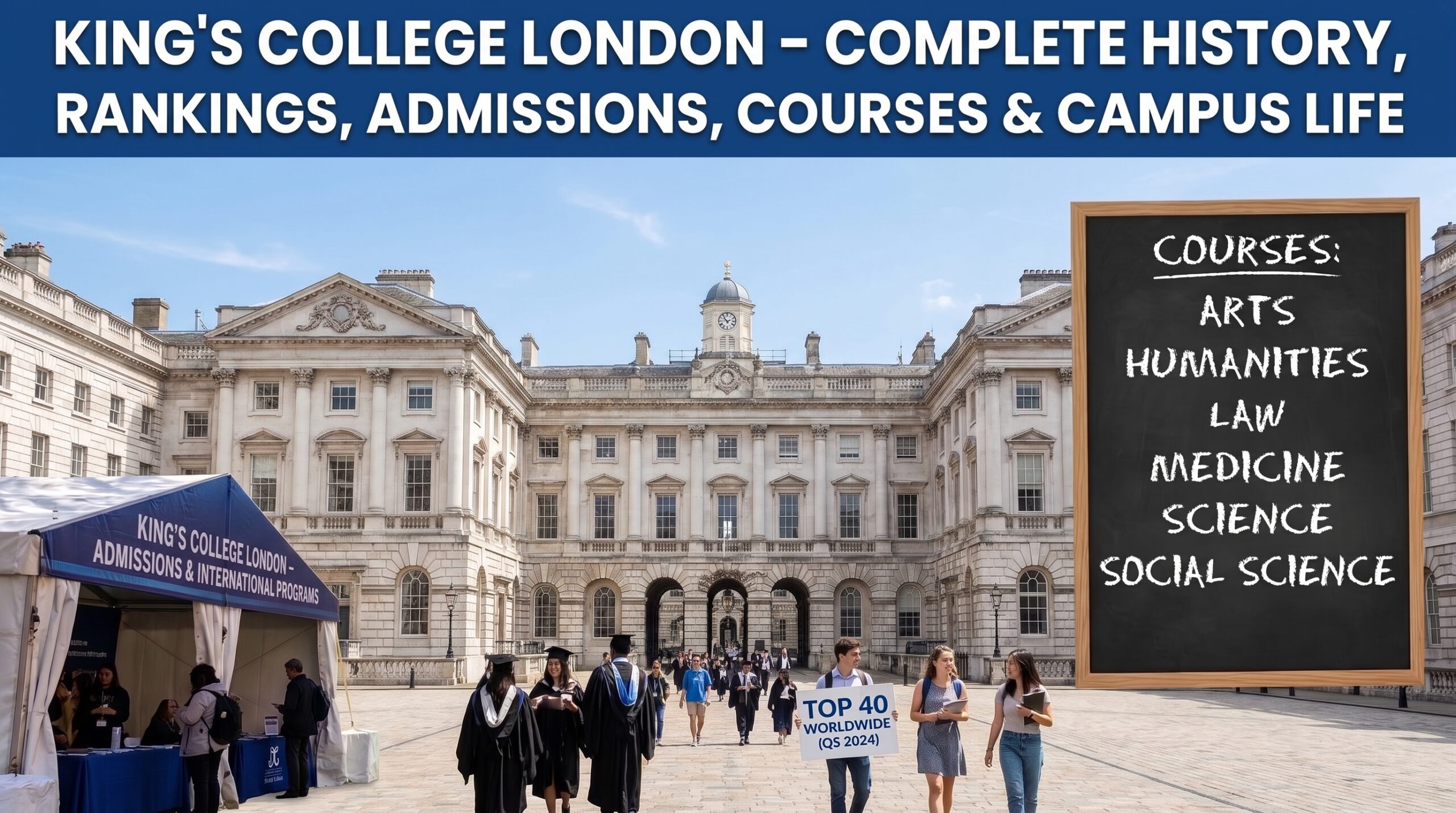
Located in the heart of London, King’s is uniquely defined by its urban integration. Its campuses are threaded through the capital’s historic and financial centers, placing students within walking distance of the Houses of Parliament, the Royal Courts of Justice, and some of the world’s most renowned teaching hospitals. This proximity is not incidental; it is central to the King’s experience, where academic theory is constantly tested against the realities of policy-making, global health, and international affairs.
King’s is renowned for being a powerhouse of progress. It was a catalyst for the discovery of the structure of DNA, it pioneered the training of nurses through the Florence Nightingale School, and it maintains one of the world’s most influential Departments of War Studies. For the modern student, King’s offers a rigorous, global community of over 40,000 students and staff, all driven by the college’s founding motto: *Sancte et Sapienter*—”With Holiness and Wisdom.”
Comprehensive History
The Founding (1829)
The establishment of King’s College London was a radical act in 19th-century Britain. At the time, the only universities in England were Oxford and Cambridge, both of which were deeply Anglican and restricted to members of the Church of England. The founding of King’s was intended as a direct response to this limitation—an institution that offered a high-level academic education with a strong emphasis on religious and moral instruction according to the Church of England, yet catering to a broader segment of the population.
A Legacy of Science and Discovery
Throughout the Victorian and Edwardian eras, King’s gained a reputation for being an early adopter of scientific progress. It was among the first institutions in the UK to establish a laboratory for the teaching of science, and its faculty were instrumental in early physics and engineering. Perhaps most famously, King’s researchers—specifically Maurice Wilkins and Rosalind Franklin—played an indispensable role in the discovery of the DNA double helix in the 1950s. While history often focuses on the work of others, the contribution of King’s scientists remains the cornerstone of modern molecular biology.
Post-War Expansion and Modernization
The 20th century saw King’s evolve from a localized London institution into a global research titan. It underwent a series of strategic mergers with several prestigious medical and dental schools, including the United Medical and Dental Schools of Guy’s and St Thomas’ Hospitals, as well as the Institute of Psychiatry. These integrations solidified King’s position as one of Europe’s leading centers for biomedical research and clinical training. Today, KCL is a core member of the Russell Group, reflecting its status as one of the UK’s top research-intensive institutions.
Rankings and Global Reputation
King’s College London maintains a world-class reputation. In the 2027 QS World University Rankings, KCL was ranked 37th globally and 6th in the United Kingdom, placing it firmly in the top 2.5% of all universities worldwide. Its reputation is particularly bolstered by its exceptional performance in health-related and social science fields.
| Ranking Indicator | 2027 QS Global Performance |
|---|---|
| Academic Reputation | 96.3% |
| International Research Network | 97.7% |
| Employer Reputation | 92.8% |
| Global Rank | 37th |
Beyond institutional rankings, King’s is consistently ranked as a global leader in subject-specific areas. In recent subject evaluations, King’s has been cited as the 1st in the UK for Health Studies, Nursing, and Dentistry, and 11th globally for both Medicine and Politics.
Admissions & Selectivity
King’s College London is highly selective. The admissions process for undergraduate study is handled via UCAS, and the university places significant emphasis on both academic excellence and the individual’s preparedness for their chosen field.
Undergraduate Entry Standards
For UK students, standard offers typically range from A*AA to AAB at A-Level. The university is rigorous in its requirements, and “soft” subjects (like General Studies or Critical Thinking) are generally excluded from offers. For international students, the requirements are equally stringent:
- International Baccalaureate: Requirements typically range from 35 to 39 points, with 6 or 7 in Higher Level subjects.
- US Applicants: KCL accepts AP and SAT/ACT scores. Typically, A*A*A at A-level is equivalent to a combination of high AP scores (5s) and strong ACT/SAT results.
- Contextual Admissions: King’s is deeply committed to social mobility. They employ a “contextualized admissions” system where they take into account an applicant’s socio-economic and educational background to provide a more holistic assessment of their potential.
The London Campuses: A Guide
King’s is unique because it doesn’t have a single “walled” campus; its identity is tied to the city itself. It operates across five main campuses, each serving as the hub for specific faculties:
- Strand Campus: The historic core, housing the Arts, Humanities, Law, and the King’s Business School. It overlooks the Thames and is a stone’s throw from the Royal Courts of Justice.
- Guy’s Campus: Located near London Bridge, this is the primary hub for the Faculty of Life Sciences & Medicine and the Dental Institute. It is integrated directly into the vibrant Borough Market area.
- Waterloo Campus: Home to the Florence Nightingale Faculty of Nursing, Midwifery & Palliative Care, emphasizing the university’s historical commitment to nursing excellence.
- St Thomas’ Campus: A vital clinical site located across the river from Parliament, focusing on medicine and research at St Thomas’ Hospital.
- Denmark Hill Campus: Located in South London, this is the center for the Institute of Psychiatry, Psychology & Neuroscience (IoPPN), a world leader in mental health research.
Courses & Subject Areas
KCL offers an exhaustive range of subjects, but it is particularly famous for those courses that leverage its London location and clinical heritage.
Flagship Subject Areas:
- War Studies: KCL is home to the world’s largest academic department dedicated to the study of war, conflict, and security.
- Medicine & Health: With over 150 years of medical training, KCL is a pioneer in clinical practice, particularly in neurosciences and molecular biology.
- Law: Located near the legal district, the Dickson Poon School of Law is one of the most prestigious in the country.
- Politics & Economics: Leveraging proximity to Westminster, KCL attracts leading academics who frequently advise the UK government on public policy.
Campus Life & Student Experience
Student life at King’s is fast-paced, professional, and cosmopolitan. Given the campus locations, students are often engaged in internships, activism, or cultural activities within the city throughout their studies.
- Societies: There are over 300 student societies, ranging from the Law Society and Medical Students’ Association to niche groups like the Film Production society.
- The KCL Student Union (KCLSU): One of the most active in London, managing venues, organizing protests, and providing support services across all campuses.
- The “London Experience”: Students aren’t just “on campus”—they are in the capital. Friday nights at a pub in Southwark, Saturday mornings at the British Library, and Sunday afternoons in Covent Garden are standard parts of the King’s student lifestyle.
Frequently Asked Questions